



Trump’s Trade Policy and Its Impact on the Indonesian Economy
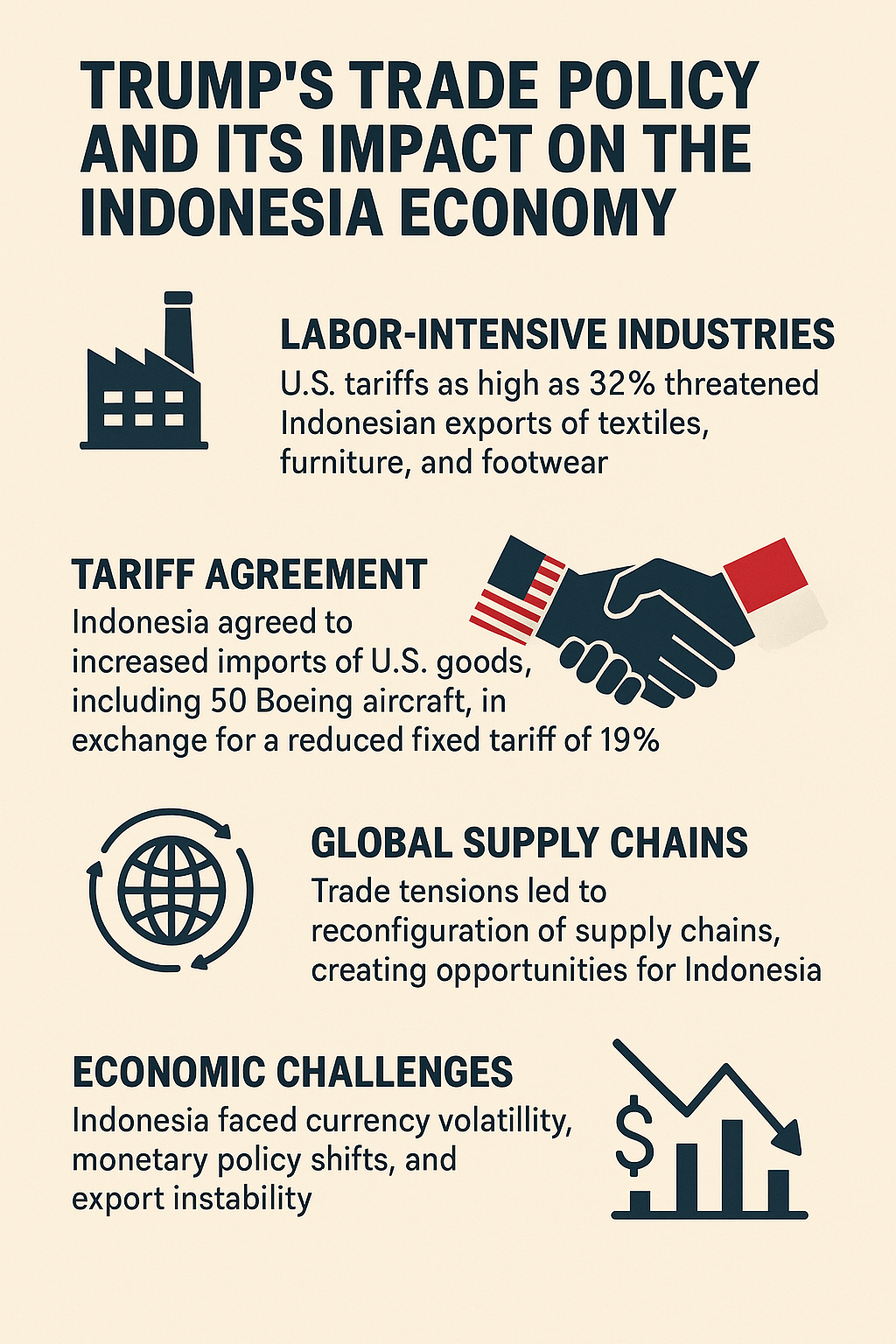
U.S. President Donald Trump’s tariff and trade policies had both direct and indirect impacts on the Indonesian economy. Under the banner of protecting American industries, the Trump administration imposed high tariffs not only on China but also on several emerging economies, including Indonesia.
Labor-intensive sectors such as textiles, furniture, and footwear were particularly affected. Indonesia had relied heavily on exports of these products to the U.S. market, but the threat of tariffs as high as 32% severely undermined the profitability of local manufacturers. As a result, some businesses, particularly small and medium-sized enterprises in the textile industry, faced reduced export orders, restructuring, and even closure.
In response, the Indonesian government engaged in high-level negotiations with the United States and eventually reached a compromise. Indonesia agreed to significantly expand its imports of American goods—most notably by committing to purchase 50 Boeing aircraft, alongside major contracts for U.S. energy and agricultural products. In return, the U.S. government imposed a reduced fixed tariff of 19% on Indonesian exports, a considerable decrease from the previously threatened 32%. Among ASEAN nations, this agreement placed Indonesia in a relatively favorable position, allowing it to maintain a measure of competitiveness in the U.S. market.
Beyond trade balances, these tensions also contributed to a global supply chain reconfiguration. As American companies sought to reduce their dependence on Chinese manufacturing, Southeast Asia—including Indonesia—emerged as an attractive alternative for investment and production. While this shift created long-term opportunities, the short-term effects included exchange rate volatility and instability in key export markets.
The Indonesian rupiah came under pressure as investors turned away from emerging market currencies amid global trade uncertainty. In response, Bank Indonesia adopted a more flexible monetary policy, cutting interest rates to support domestic demand and stabilize financial markets. Nonetheless, economic recovery remained gradual.
Ultimately, Trump’s tariff policies delivered a short-term shock and exposed structural challenges within Indonesia’s economy. However, they also served as a wake-up call. In the aftermath, Indonesia began accelerating efforts to diversify its export base, attract supply chain investment, and upgrade its manufacturing capabilities. These developments suggest a shift toward a more resilient and competitive economic model in the long term.
Comments :