



The ASEAN Business Landscape in 2026: Challenges, Opportunities, and Future Outlook
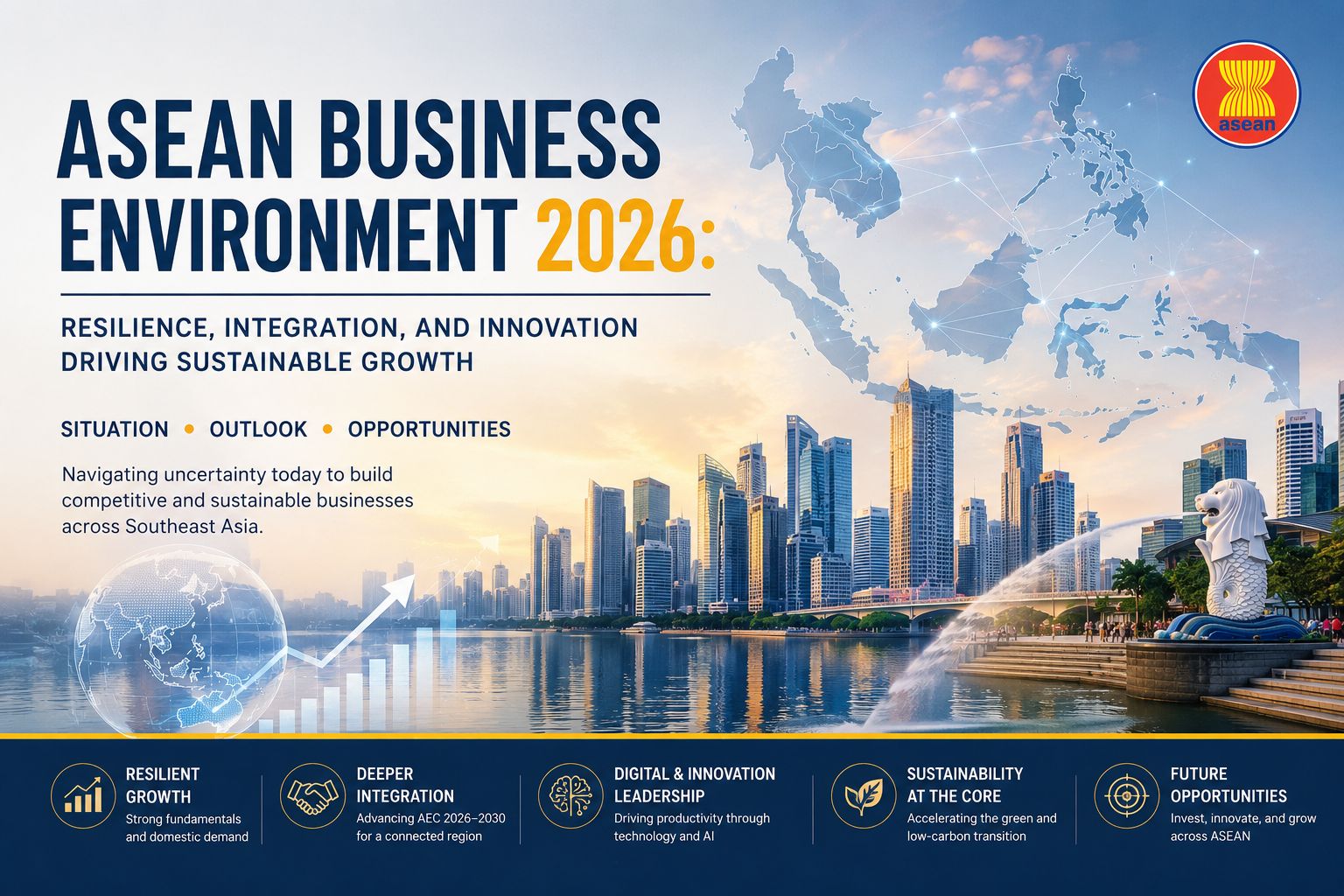
The ASEAN business environment in 2026 remains relatively resilient despite increasing global uncertainty. Southeast Asia continues to benefit from strong domestic consumption, growing digital economies, expanding middle-class populations, and sustained foreign direct investment (FDI). Countries such as Indonesia, Vietnam, Malaysia, and the Philippines remain attractive destinations for manufacturing diversification, supply chain relocation, and digital investment. Regional economic growth is expected to remain above many advanced economies, with ASEAN maintaining growth of around 4–5% across major member states.
However, the business landscape is becoming more challenging. Rising geopolitical tensions, trade policy uncertainty, disruptions in global supply chains, and higher energy prices driven by conflicts in the Middle East have increased operational costs and market volatility. ASEAN businesses are facing growing pressure to improve resilience, diversify suppliers, strengthen risk management systems, and accelerate digital transformation initiatives. Inflationary pressures and exchange-rate fluctuations also remain important concerns for firms operating across multiple markets.
At the regional level, ASEAN is pursuing deeper economic integration through the ASEAN Economic Community (AEC) Strategic Plan 2026–2030. The plan emphasizes trade facilitation, regulatory harmonization, sustainable development, financial integration, and stronger regional connectivity. These initiatives are expected to improve cross-border business operations and enhance ASEAN’s attractiveness as a long-term investment destination.
Looking ahead, business expectations for ASEAN remain cautiously optimistic. While external risks are likely to persist, companies are expected to increase investments in digitalization, artificial intelligence, sustainability (ESG), renewable energy, and regional supply chain networks. Firms that successfully combine technological innovation with sustainability strategies and regional market expansion are likely to be the primary beneficiaries of ASEAN’s continued economic transformation over the coming decade.
Comments :