



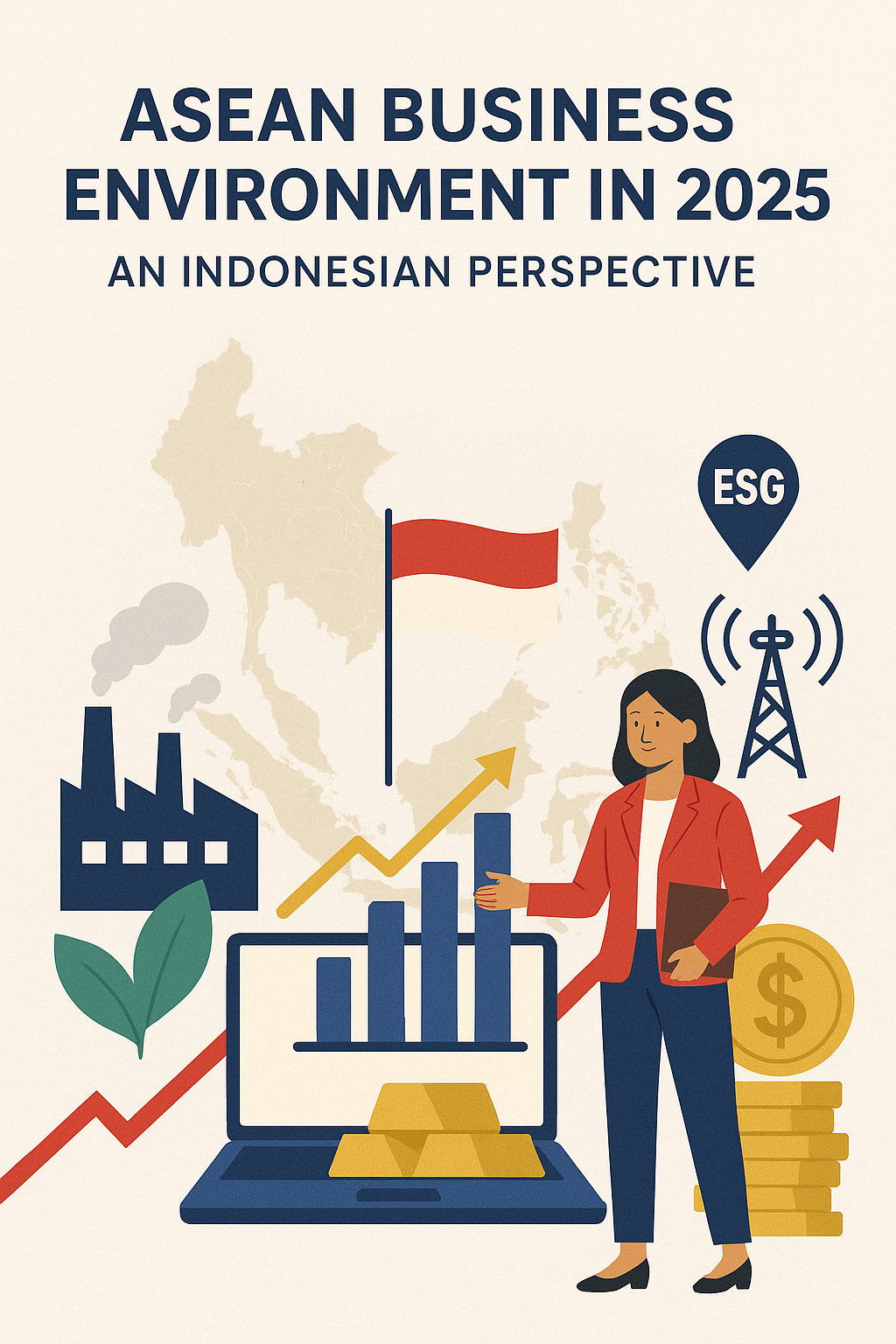
ASEAN Business Environment in 2025: Insights and Direction from Indonesia’s Perspective
ASEAN (the Association of Southeast Asian Nations) has emerged beyond a regional cooperative body to become a core driver of global economic growth. With a population exceeding 680 million and a GDP approaching USD 4 trillion as of 2025, ASEAN is gaining global attention for its progress in trade, investment, technological innovation, and sustainability. At the center of this development is Indonesia, the largest ASEAN member by both population and economic size.
Today, ASEAN is restructuring its economic vision around digital integration, green transformation, and long-term resilience. Supranational agreements such as the RCEP (Regional Comprehensive Economic Partnership) are lowering trade barriers, reconfiguring supply chains, and boosting investment flows across the region. Member countries are collaborating on issues like energy security, digital governance, and social inclusion. Indonesia is not a passive participant in these processes—it is actively shaping the direction of regional integration.
Indonesia’s rapid advancement in the digital sector is especially noteworthy. Its digital economy is projected to grow to between USD 150–200 billion by 2030 (Google, Temasek & Bain, 2023). Companies such as Tokopedia, Gojek, Halodoc, and Ruangguru have transformed everyday life in Indonesia, redefining commerce, transportation, healthcare, and education. These platforms are more than just services—they form digital ecosystems that create jobs and shift consumer expectations. Indonesia is no longer merely adopting digital trends; it is now leading them.
The country is also taking significant strides toward environmental sustainability. Indonesia has set a national target to achieve net-zero emissions by 2060 and is accelerating investment in renewable energy, electric vehicles, green finance, and sustainable agriculture (IEA, 2022). Both public and private sectors are integrating ESG (Environmental, Social, and Governance) standards into their strategies—positioning Indonesia as an emerging green economy in the region and attracting environmentally conscious investors.
One of the most symbolic and ambitious initiatives underway is the relocation of Indonesia’s capital to Nusantara in East Kalimantan. Far from being a simple administrative move, this relocation reflects a bold vision for building a smart, sustainable, and inclusive city of the future. Plans include green infrastructure, digital government systems, and energy independence. For domestic and international companies, it presents unprecedented business opportunities in infrastructure, smart city technology, and real estate development (BAPPENAS, 2023).
Indonesia is also rising in importance as a strategic manufacturing hub, particularly as global supply chains shift away from China. With ongoing investments in ports, highways, and special economic zones, the Indonesian government is actively improving its logistics and industrial base to attract foreign direct investment. Despite challenges—such as complex regulatory systems, a shortage of skilled labor in high-tech industries, and regional development gaps—these are also opportunities for innovation and long-term growth.
The future business landscape of ASEAN and Indonesia is blurring traditional industry lines. Business success will increasingly rely on integrating technology, environmental considerations, and governance systems. Organizations will need to prioritize digital capacity, ESG-aligned strategies, and stronger regional connectivity. Among ASEAN members, Indonesia is uniquely positioned with both the resources and ambition to lead this transformation.
Now is the time to look at Indonesia with fresh strategic eyes and reimagine engagement in Southeast Asia. Indonesia is not just adjusting to the future—it is creating it. For businesses, investors, and global partners, this is not just a period of observation—it is a moment to act.
Date: February 12, 2025
References
-
Google, Temasek, & Bain & Company. (2023). e-Conomy SEA 2023 Report. https://economysea.withgoogle.com
-
International Energy Agency (IEA). (2022). Southeast Asia Energy Outlook 2022. https://www.iea.org
-
Ministry of National Development Planning (BAPPENAS). (2023). Nusantara Capital City Masterplan. Government of Indonesia
-
ASEAN Secretariat. (2024). ASEAN Integration Report 2024. https://asean.org
-
World Bank. (2023). Indonesia Economic Prospects: Accelerating Reforms for a Green and Digital Future. https://www.worldbank.org
Comments :