


From “Tetangga” to the World: Kopi Tuku’s Mindful Path to Global Competitiveness
Background: The Engine of Indonesia’s Economy
Small and Medium Enterprises (SMEs) are the true backbone of Indonesia. They represent roughly 99% of all business units in the country. They also contribute around 61% to the national GDP and absorb 97% of the total workforce[1]. Within this ecosystem, the Food and Beverage (FnB) sector is a dominant player that makes up over 40% of the creative economy. One brand that has redefined this sector is Toko Kopi Tuku. Founded in 2015 in Cipete, Tuku moved away from the traditional coffee shop model. Instead of building massive and expensive cafes, they focused on a “tetangga” (neighbor) philosophy. They created a community-based model that offers everyday luxury at an affordable price[2].
The Problem: Breaking into the European Market
For a local brand like Tuku, moving from the streets of Jakarta to the cities of Europe is a massive challenge. The obstacles are not just financial. They also face heavy regulatory and cultural barriers:
- The Green Barrier (EUDR): The European Union has implemented the EU Deforestation Regulation (EUDR). This law requires all coffee imports to be certified as “deforestation-free.” For SMEs working with small local farmers, providing this digital proof of origin is extremely difficult and expensive.
- The Scaling Trap: Many Indonesian brands fail when they grow too fast. Tuku’s founder, Andanu Prasetyo, emphasizes mindful expansion. They refuse to be hyper-scalers who open thousands of stores just for profit. They fear that rapid growth will destroy the consistent quality and soul of the brand.
- Global Competition: In Europe, Tuku must compete with global multinational companies (MNCs) that have established supply chains and huge marketing budgets.
Analysis: Why Traditional Scaling Fails
Attempting to beat global coffee conglomerates by lowering prices or building huge stores is a losing battle for an SME. Traditional scaling often leads to a loss of brand identity. Tuku takes a totally different approach. They use a mindful strategy where they test international markets like Seoul and the Netherlands through pop-up stores first. This allows them to listen to the market and build a connection with the Indonesian diaspora before committing to permanent locations. In international business today, following the Triple Bottom Line (Profit, People, Planet) is no longer an option. It is a strict requirement to survive in the European market.
Strategic Solutions: Digital Tools and Focused Innovation
Tuku can overcome international barriers by combining their unique culture with modern business strategies:
- Digital Traceability: To satisfy EUDR rules, Tuku can adopt digital supply chain tracking. Using simple digital logs or blockchain allows them to provide transparent proof of origin. This turns a complex regulation into a competitive advantage.
- Leveraging the Diaspora: The Netherlands has a huge Indonesian diaspora. By treating them as the new tetangga, Tuku can create an instant customer base that acts as a bridge to local European consumers.
- Specialty Innovation: Tuku does not just copy Western menus. They use local resources like coconut and palm sugar (gula aren). In Europe, these are considered specialty ingredients. Selling these high-margin unique flavors allows Tuku to avoid a price war with MNCs.
The Impact and Future Projections for Indonesia’s GDP
The success of brands like Tuku has a direct impact on Indonesia’s national goals. Currently, Tuku’s domestic performance shows how an SME can drive massive economic-velocity[3].
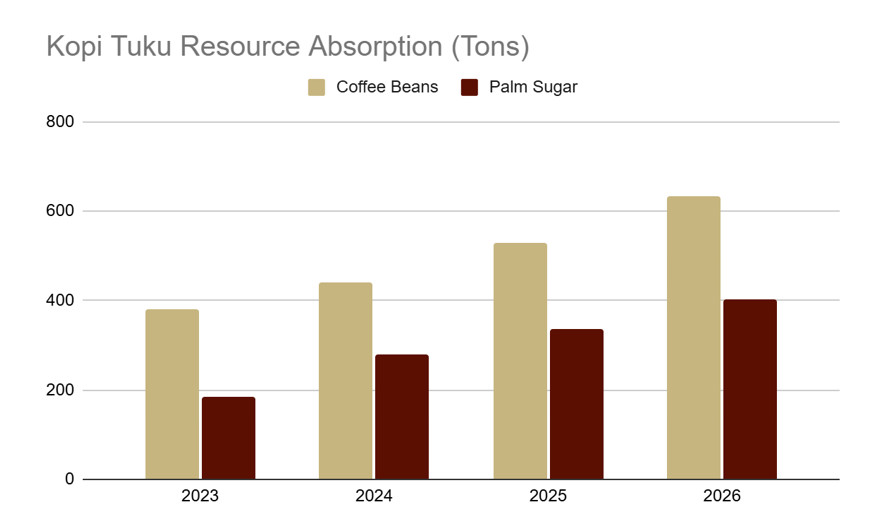
This growth proves that as Tuku expands, the local agricultural sector grows with them. On a macro level, Southeast Asia’s digital economy is projected to reach $300 billion by 2026[4]. Furthermore, global financial experts project that Indonesia is on track to become the world’s 4th largest economy by 2030 with a GDP exceeding $10 trillion[5]. For Indonesia to hit this target, it needs SMEs to graduate into global players. Tuku is a prime example of how an Indonesian brand can lead the country toward that top global ranking.
Conclusion
In conclusion, Kopi Tuku proves that Indonesian SMEs can successfully internationalize. By choosing mindful expansion and digital traceability over direct wars with MNCs, local brands can turn strict regulations into opportunities, ultimately driving Indonesia’s GDP to the global stage.
References:
[1] Ministry of Cooperatives and SMEs. (2025). Annual report on MSME economic contribution.
[2] Nugroho, I. [Dr. Indrawan Nugroho]. (2025, April 15). Strategi mindfull expansion ala Kopi Tuku [Video]. YouTube. https://youtu.be/V_Kitz2RvJ8
[3] Investor Trust. (2024). Kopi Tuku catat peningkatan pendapatan 77%. https://investortrust.id/business/31624/
[4] Google, Temasek, & Bain & Company. (2025). e-Conomy SEA: Unlocking the digital potential of Southeast Asia. https://economysea.withgoogle.com/
[5] Indonesia Baik. (2019). Tahun 2030, PDB PPP Indonesia Peringkat ke-4. Direktorat Jenderal Informasi dan Komunikasi Publik Kemkominfo. https://indonesiabaik.id/infografis/tahun-2030-pdb-ppp-indonesia-peringkat-ke-4
Comments :