


The History of Lean Manufacturing: From Origins to the Digital Frontier
- Introduction
Lean Manufacturing, a paradigm-shifting philosophy and operational methodology, transcends mere cost-cutting to represent a systematic pursuit of perfection. Its core tenet lies in the relentless elimination of waste (Muda) across all facets of a production system, thereby maximizing productivity, enhancing quality, and improving customer value. What began as a set of pragmatic solutions to post-war industrial challenges has blossomed into a sophisticated, technology-agnostic framework that continues to redefine operational excellence across diverse industries globally. This comprehensive article delves into the intricate historical evolution of Lean Manufacturing, dissecting its foundational principles, examining its profound impact on value chain transformation and organizational models, and presenting a detailed case study to illustrate its real-world efficacy. The discussion further explores the convergence of Lean with contemporary technological advancements, particularly within the context of Industry 4.0, and concludes with a forward-looking perspective on its enduring relevance.
- Historical Evolution of Lean Manufacturing
The trajectory of Lean Manufacturing is a compelling narrative of continuous innovation, adapting to economic pressures, technological shifts, and evolving market demands. Its roots are firmly embedded in the principles of industrial efficiency, which were first rigorously explored during the dawn of mass production.
2.1 The Industrial Revolution and the Genesis of Mass Production (18th – Early 20th Century)
The Industrial Revolution, a period of profound technological advancement from approximately 1760 to 1840, laid the groundwork for modern manufacturing by introducing mechanization and the factory system. While not directly Lean, this era fostered an environment where the optimization of production processes became a central focus.
- Frederick Taylor’s Scientific Management (1890s): Often considered the “father of scientific management,” Frederick Winslow Taylor’s pioneering work revolutionized industrial efficiency. Through meticulous time and motion studies, he sought to identify the “one best way” to perform a task, standardize work processes, and improve labor productivity (Taylor, 1911). Taylor’s approach, while critiqued for its mechanistic view of labor, emphasized systematic analysis and optimization, concepts that would later be refined within Lean. His focus on reducing wasted effort and standardizing processes foreshadowed Lean’s emphasis on efficiency.
- Henry Ford’s Assembly Line (1913): Henry Ford’s innovations at the Ford Motor Company, particularly the moving assembly line, marked a pivotal moment in industrial history. By combining standardized, interchangeable parts with a continuous flow production system facilitated by conveyor belts, Ford drastically reduced the time and cost of manufacturing automobiles (Ford, 1926). This era ushered in the age of mass production, making products more accessible and affordable to a wider population.
Despite these monumental advancements, mass production, as conceived by Ford and his contemporaries, harbored inherent inefficiencies. The “push system” model, characterized by producing goods based on forecasts rather than actual demand, often led to: * Excessive Inventory: Large stockpiles of raw materials, work-in-progress, and finished goods tied up capital and required significant storage space, leading to waste from obsolescence, damage, and handling. * Inflexible Product Variations: The focus on standardization made it difficult and costly to introduce product variations or adapt quickly to changing customer preferences. * Limited Adaptability to Market Changes: The rigid nature of mass production lines made them slow to respond to fluctuations in demand or new competitive pressures. * Waste of Overproduction: Producing more than what was immediately needed resulted in storing goods that might not sell, incurring carrying costs and potential spoilage.
These limitations set the stage for a new approach that would fundamentally challenge the prevailing manufacturing orthodoxy.
2.2 The Birth of the Toyota Production System (TPS) (1940s – 1970s)
The crucible for the development of what would become Lean Manufacturing was post-World War II Japan. Faced with severe resource scarcity, limited capital, and a smaller domestic market compared to the U.S., Japanese manufacturers, particularly Toyota, could not afford the inefficiencies inherent in the American mass production model. This necessity became the mother of invention, leading to the meticulous development of the Toyota Production System (TPS) under the visionary leadership of Kiichiro Toyoda, Taiichi Ohno, and Shigeo Shingo. TPS was not merely a collection of tools; it was a deeply ingrained philosophy focused on identifying and eliminating waste while continuously improving processes (Ohno, 1988).
The core principles that defined TPS, and subsequently Lean Manufacturing, include:
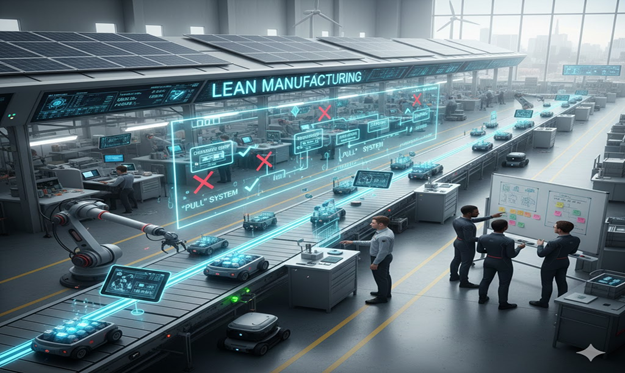
- Just-in-Time (JIT): This foundational principle mandates producing only what is needed, in the amount needed, and when it is needed. JIT aims to eliminate overproduction, reduce inventory, and streamline the flow of materials and information. It shifts from a “push” to a “pull” system, where production is triggered by actual customer demand. Kanban, a visual signaling system, is a key tool for implementing JIT.
- Jidoka (Automation with a Human Touch): Jidoka refers to the ability of a production line to stop automatically when an abnormal condition or defect is detected. This principle empowers workers to halt production, fostering a culture where quality is built into the process rather than inspected in at the end. It prevents the propagation of defects and encourages immediate problem-solving, leading to higher quality and reduced rework.
- Kaizen (Continuous Improvement): Kaizen is a philosophy of continuous, incremental improvement involving all employees, from top management to shop-floor workers. It emphasizes that even small, sustained changes can lead to significant long-term gains. This culture fosters problem-solving, innovation, and a collective responsibility for process optimization.
- Heijunka (Production Leveling/Smoothing): Heijunka aims to level out the production schedule to avoid peaks and valleys in demand. By distributing production volume and mix evenly over time, it reduces the need for large inventories, stabilizes workflow, and minimizes the “Mura” (unevenness) in production, leading to more efficient resource utilization.
- Elimination of Muda, Mura, Muri (The Three Ms of Waste): These are the core targets for elimination in Lean:
- Muda (Waste): Any activity that consumes resources but does not add value to the customer. Ohno identified seven common types of Muda: overproduction, waiting, unnecessary transport, over-processing, excess inventory, unnecessary motion, and defects.
- Mura (Unevenness): Irregularity or inconsistency in an operation, leading to bottlenecks or idle time.
- Muri (Overburden): Overburdening equipment or people, leading to breakdowns, defects, or injuries.
The remarkable efficiency and quality achieved by TPS gradually garnered international attention. This culminated in the landmark 1990 MIT study, “The Machine That Changed the World: The Story of Lean Production” (Womack, Jones, & Roos, 1990). This seminal work not only meticulously documented the principles and practices of TPS but also formally coined the term “Lean Production” (later “Lean Manufacturing”), making it accessible to a wider global audience and sparking its widespread adoption.
2.3 The Expansion of Lean Manufacturing (1990s – Present)
Following the publication of “The Machine That Changed the World,” Lean principles transcended the confines of automotive manufacturing and began to permeate a vast array of industries. The universal applicability of waste reduction and value creation resonated with organizations facing competitive pressures and seeking improved performance.
- Cross-Industry Adoption: From healthcare (e.g., optimizing patient flow, reducing medical errors) to aerospace (e.g., streamlining aircraft production), finance (e.g., accelerating loan processing), and software development (e.g., Agile methodologies), Lean principles proved adaptable and effective in diverse contexts. The focus shifted from merely manufacturing to “Lean Enterprise,” encompassing all aspects of an organization.
- Lean Six Sigma (2000s): This powerful methodology emerged as a synergistic integration of Lean Manufacturing’s focus on speed and waste reduction with Six Sigma’s rigorous statistical approach to quality improvement and defect reduction. Lean Six Sigma provides a comprehensive framework for process improvement, allowing organizations to achieve both efficiency and high quality simultaneously. Key proponents like Michael George (2002) detailed the benefits of this combined approach, leading to its widespread adoption across industries seeking both speed and precision.
- Lean Industry 4.0 (2010s – Present): The advent of Industry 4.0, characterized by the convergence of digital technologies, automation, and data exchange in manufacturing, presents a significant evolution for Lean. Rather than replacing Lean, Industry 4.0 technologies are increasingly seen as powerful enablers and accelerators of Lean principles. This synergy, sometimes referred to as “Lean Digital Transformation,” involves:
- Artificial Intelligence (AI): For predictive maintenance, demand forecasting, quality control, and optimizing complex processes.
- Internet of Things (IoT): For real-time data collection from sensors on machinery, enabling precise monitoring, anomaly detection, and condition-based maintenance.
- Big Data Analytics: To process vast amounts of operational data, identify patterns, uncover root causes of inefficiencies, and inform data-driven decision-making.
- Cloud Computing: For scalable data storage, processing, and collaborative platforms, supporting real-time information sharing across the value chain.
- Cyber-Physical Systems (CPS): Integrating computational and physical components, leading to smart factories capable of autonomous decision-making and self-optimization. Rüttimann & Stöckli (2016) discuss how Lean and Industry 4.0 can be complementary, with Industry 4.0 tools providing the data and automation needed to achieve higher levels of Lean performance.
- Transformation of the Value Chain
The concept of the value chain, which describes the full range of activities required to create a product or service, undergoes a fundamental transformation under Lean principles.
3.1 Pre-Lean Value Chain: The Mass Production Model
In the traditional mass production model, the value chain is typically:
- Linear and Rigid: Processes are sequential, with each department operating relatively independently. This creates “silos” and hinders seamless information flow.
- Push System: Production is driven by forecasts and planned schedules, pushing products through the chain regardless of immediate customer demand. This often results in overproduction and the accumulation of large inventories at various stages.
- High Waste Levels: The inherent inflexibility and batch-and-queue nature of mass production lead to significant waste in the form of excessive inventory, waiting times, over-processing, and difficulty in identifying and correcting defects early. Value is added at specific, isolated points, often with considerable non-value-added activities in between.
3.2 Lean Value Chain: The Toyota Production System
The Lean value chain, epitomized by TPS, represents a radical departure from the mass production paradigm. It is characterized by:
- Pull System: Production is initiated only when a downstream process or customer signals a need. This demand-driven approach minimizes overproduction and aligns production directly with actual consumption.
- Just-in-Time (JIT) Principle: By producing and delivering components or products precisely when they are needed, JIT drastically reduces inventory levels, storage costs, and the risk of obsolescence. This fosters a continuous flow and exposes inefficiencies quickly.
- Continuous Flow and Single-Piece Flow: Lean strives to move products through the value chain one piece at a time (or in very small batches) with minimal interruptions. This reduces lead times, improves quality by quickly identifying defects, and enhances flexibility.
- Value Stream Mapping (VSM): A critical Lean tool, VSM visually depicts the entire flow of materials and information required to bring a product or service to the customer. It helps identify all value-adding and non-value-adding activities, enabling teams to pinpoint sources of waste and design future-state processes.
- Continuous Improvement (Kaizen): The value chain is not static but constantly refined through ongoing Kaizen activities. Employees are encouraged to identify and eliminate waste, improving efficiency and flexibility across the entire chain.
- Supplier Integration: Lean extends beyond the internal operations, fostering close, collaborative relationships with suppliers. This ensures timely delivery of high-quality materials and components, supporting the JIT system and extending Lean principles upstream.
3.3 Lean in the Digital Era (Industry 4.0)
The integration of Industry 4.0 technologies elevates the Lean value chain to unprecedented levels of efficiency, responsiveness, and intelligence.
- Smart Factories and Connected Systems: IoT sensors embedded in machinery and products provide real-time data on production status, equipment performance, and material flow. This creates a fully connected ecosystem where processes can self-optimize and respond dynamically to changes.
- Predictive Analytics and AI-driven Optimization: AI algorithms analyze vast datasets from IoT devices to predict equipment failures, forecast demand more accurately, optimize production schedules, and identify potential bottlenecks before they occur. This moves from reactive problem-solving to proactive prevention.
- Cloud-based Manufacturing and Decentralized Decision-Making: Cloud platforms enable real-time information sharing across the entire extended value chain, from suppliers to customers. This fosters greater transparency, facilitates collaborative decision-making, and supports a more decentralized, agile approach to production management.
- Automation and Cyber-Physical Systems (CPS): Advanced robotics, automated guided vehicles (AGVs), and CPS further streamline material handling, assembly, and inspection processes. These systems reduce human error, enhance precision, and optimize resource allocation, contributing to Mura and Muri reduction.
- Digital Twin Technology: Creating virtual replicas of physical assets, processes, or entire factories allows for simulations and optimizations in a digital environment before implementing changes in the real world. This reduces risk and accelerates improvement cycles.
- Enhanced Traceability and Quality Control: Digital technologies provide end-to-end traceability of products and components, improving quality control and enabling rapid identification and containment of defects.
- Organizational Models in Lean Manufacturing
The successful implementation of Lean Manufacturing necessitates a fundamental shift in organizational structure, culture, and leadership style.
4.1 Traditional Organizational Model (Pre-Lean)
Prior to Lean, most industrial organizations operated under models characterized by:
- Hierarchical and Bureaucratic Structure: Command-and-control structures with multiple layers of management. Decision-making authority is concentrated at the top.
- Siloed Departments: Departments operate in isolation, with limited cross-functional communication or collaboration. This leads to sub-optimization and hinders holistic process improvement.
- Top-Down Decision-Making: Strategic and operational decisions are made by senior management and cascaded down, often without sufficient input from those directly involved in the work. This can lead to slow response times and a lack of ownership at lower levels.
- Functional Specialization: Employees are highly specialized in narrow tasks, potentially leading to a lack of understanding of the overall value stream.
- Reactive Problem-Solving: Issues are often addressed only after they become significant problems, leading to firefighting rather than proactive prevention.
4.2 Lean Organizational Model
The Lean organizational model fosters an environment of continuous improvement, employee empowerment, and customer focus. Key characteristics include:
- Flattened Hierarchy with Empowered Employees: Lean organizations reduce management layers and delegate decision-making authority closer to the gemba (the place where the work is done). Frontline employees are empowered to identify problems, propose solutions, and implement improvements, fostering a sense of ownership and responsibility.
- Cross-Functional Teams for Continuous Improvement: Lean emphasizes collaboration across departments and functions. Teams composed of individuals from different areas work together to analyze value streams, identify waste, and implement Kaizen initiatives. This breaks down silos and promotes a holistic view of processes.
- Gemba Principle and Go-See: Managers and leaders are expected to regularly go to the gemba to observe processes, understand challenges firsthand, and engage with employees. This “go-see” approach fosters a deeper understanding of the work and enables more effective problem-solving and support.
- Servant Leadership: Lean leaders act as facilitators and coaches, supporting their teams, removing obstacles, and developing their problem-solving capabilities, rather than dictating tasks.
- Visual Management: The use of visual aids (e.g., Kanban boards, production control charts, performance metrics) makes the status of processes immediately clear to everyone, facilitating quick identification of issues and fostering transparency.
- Standardized Work: While seemingly rigid, standardized work in Lean provides a baseline for consistency and quality, making it easier to identify deviations and opportunities for improvement. It forms the foundation for Kaizen.
4.3 Lean Digital Organization (Industry 4.0)
The integration of Industry 4.0 technologies further refines the Lean organizational model, emphasizing data-driven insights and agile structures.
- Data-Driven Decision-Making: Access to real-time data from IoT sensors, AI analytics, and digital platforms enables faster, more informed decisions. This shifts from intuition-based decisions to evidence-based strategies, allowing for proactive adjustments and optimization.
- Agile Structures and Global Collaboration: Digital tools and cloud-based platforms facilitate seamless collaboration across geographically dispersed teams and functions. This supports agile methodologies, allowing organizations to rapidly adapt to market changes and innovate at an accelerated pace.
- Real-time Monitoring and Performance Transparency: Dashboards and digital twins provide real-time visibility into operational performance, allowing for immediate identification of deviations, bottlenecks, and quality issues. This fosters a culture of immediate problem-solving and accountability.
- Digital Skill Development: The Lean digital organization requires a workforce equipped with new skills in data analytics, automation, and digital literacy. Continuous learning and upskilling become crucial.
- Cybersecurity and Data Governance: With increased connectivity and data exchange, robust cybersecurity measures and data governance frameworks become paramount to protect sensitive information and ensure data integrity.
- Human-Machine Collaboration: Industry 4.0 does not necessarily replace human workers but augments their capabilities. Humans and machines collaborate in symbiotic ways, with automation handling repetitive tasks and humans focusing on complex problem-solving, innovation, and strategic oversight.
- Case Study: Toyota’s Lean Transformation – A Paradigm of Operational Excellence
Toyota’s journey is not merely a historical footnote; it is the definitive case study for Lean Manufacturing, demonstrating the power of a holistic, long-term commitment to its principles.
5.1 Background
In the aftermath of World War II, Japan’s industrial landscape was shattered. Toyota, then a nascent automobile manufacturer, faced immense challenges: a dire scarcity of resources (materials, capital, energy), a small domestic market that couldn’t support mass production volumes, and the overwhelming dominance of American automotive giants like Ford and GM. They understood that simply imitating the American model of large-batch production would lead to certain failure given their unique constraints. This existential crisis forced them to innovate a fundamentally different, more resource-efficient approach.
5.2 Implementation of Lean Practices (The Genesis of TPS)
Under the leadership of Kiichiro Toyoda (who articulated the need for “just-in-time” production), Taiichi Ohno (who systematized and implemented many core TPS elements on the shop floor), and Shigeo Shingo (who contributed significantly to concepts like Poka-Yoke and SMED), Toyota meticulously developed and refined the Toyota Production System.
- Just-in-Time (JIT): Toyota revolutionized inventory management by focusing on producing parts only when they were needed by the next production stage. This was meticulously implemented through:
- Kanban System: Instead of relying on production schedules, Toyota introduced Kanban cards as a visual signaling system. A Kanban card pulled a specific number of parts from the preceding process or supplier, acting as a demand signal. This “pull” system dramatically reduced excess inventory, freed up capital, and highlighted production bottlenecks immediately.
- Reduced Batch Sizes: Moving away from large-batch production to smaller, more manageable batches, even single-piece flow where possible, further minimized work-in-progress inventory and shortened lead times.
- Jidoka: Toyota empowered its workers and machinery with the ability to detect abnormalities and stop the production line.
- Andon Cords: Workers could pull an Andon cord to immediately halt the line if they spotted a defect or a problem, preventing further defective products from being made. This fostered a culture of immediate problem-solving and quality at the source.
- Automated Machine Stops: Machines were designed to stop automatically if they encountered an issue (e.g., a broken tool, a missing part), embodying Jidoka’s principle of “automation with a human touch.”
- Kaizen Culture: Continuous improvement became deeply ingrained in Toyota’s DNA.
- Employee Engagement: Every employee, from the assembly line to management, was encouraged and trained to identify waste, solve problems, and suggest improvements, no matter how small. Problem-solving cycles like the “PDCA (Plan-Do-Check-Act)” were widely adopted.
- Gemba Walks: Managers regularly visited the shop floor (gemba) to observe processes, talk to employees, and identify improvement opportunities firsthand.
- Heijunka: To stabilize production and avoid the “Mura” (unevenness) that leads to Muri (overburden) and Muda (waste), Toyota implemented production leveling.
- Mixed-Model Production: Instead of producing large batches of one model followed by another, Toyota leveled production by mixing different models on the same line, producing a consistent mix daily or even hourly. This smoothed demand for components and stabilized workflow.
- Reduced Set-Up Times (SMED): Shigeo Shingo’s work on Single-Minute Exchange of Die (SMED) significantly reduced the time it took to change over equipment from producing one product to another. This enabled smaller batch sizes and greater production flexibility, supporting Heijunka.
5.3 Results
The diligent and pervasive application of TPS principles yielded astonishing results for Toyota:
- Dramatic Productivity Increase: Within a decade of seriously implementing TPS, Toyota saw its productivity surge by over 50%, allowing it to produce more cars with fewer resources.
- Significant Defect Rate Reduction: The focus on “quality at the source” and Jidoka led to a reduction in defect rates by over 60%, establishing Toyota’s reputation for superior quality and reliability.
- Market Leadership and Global Dominance: By meticulously perfecting its production system, Toyota consistently outmaneuvered competitors. By 2008, it surpassed General Motors to become the world’s largest automobile manufacturer, a position it has largely maintained, demonstrating the enduring competitive advantage derived from its Lean foundation.
- Resilience and Adaptability: The inherent flexibility of TPS allowed Toyota to navigate economic downturns and market shifts more effectively than its mass production counterparts.
5.4 Lessons Learned
Toyota’s unparalleled success serves as a profound lesson for any organization aspiring to Lean transformation:
- Long-Term Commitment to Lean Culture: Lean is not a short-term project or a set of tools to be superficially applied. It requires a deep, sustained, and unwavering commitment from top leadership to foster a culture of continuous improvement, respect for people, and waste elimination.
- Continuous Employee Engagement and Empowerment: The success of Lean hinges on empowering and engaging every employee in the improvement process. Their insights from the gemba are invaluable, and their buy-in is critical for successful implementation.
- Holistic System Thinking: Lean is a system, not a collection of isolated tools. Its principles (JIT, Jidoka, Kaizen, Heijunka) are interconnected and mutually reinforcing. Successful implementation requires understanding these interdependencies and adopting a holistic view of the entire value stream.
- Integration with Modern Technologies: While TPS originated before the digital age, Toyota has consistently embraced new technologies to further enhance its Lean operations. This demonstrates that Lean is not antithetical to technology but rather an adaptable framework that can leverage digital tools (like AI, IoT, and analytics) to achieve even greater levels of performance. It highlights that Lean provides the why and what (eliminate waste, maximize value), and technology provides the how (tools to achieve it faster and smarter).
- Learning and Adaptability: Toyota’s journey involved constant learning, experimentation, and adaptation. They were willing to challenge existing paradigms and continuously refine their processes based on feedback and results.
- Conclusion
The journey of Lean Manufacturing, from its humble origins in post-war Japan to its sophisticated integration with Industry 4.0, represents one of the most impactful operational philosophies in modern history. It has fundamentally transformed how organizations perceive and manage value creation, shifting from rigid, push-based mass production to agile, pull-based, and waste-minimized systems.
The core principles of the Toyota Production System—Just-in-Time, Jidoka, Kaizen, Heijunka, and the relentless pursuit of eliminating Muda, Mura, and Muri—remain the bedrock of Lean. However, the modern era has seen these principles intelligently amplified by the power of digital technologies. Industry 4.0 tools such as Artificial Intelligence, the Internet of Things, big data analytics, and cloud computing are not replacing Lean but rather empowering it to achieve unprecedented levels of efficiency, quality, and responsiveness. Smart factories, predictive maintenance, real-time decision-making, and enhanced global collaboration are all tangible benefits of this Lean-digital synergy.
Looking ahead, the future of Lean Manufacturing will undoubtedly continue to evolve. Key trends will likely include:
- AI-driven Lean Systems: Increasingly sophisticated AI will enable more autonomous process optimization, predictive problem-solving, and hyper-personalized production.
- Sustainability as a Core Lean Principle: Beyond traditional waste, Lean will increasingly focus on environmental waste (e.g., energy consumption, carbon footprint, material usage), making sustainability an integral component of value stream optimization.
- Enhanced Digital Collaboration and Supply Chain Integration: Advanced digital platforms will facilitate even deeper integration across the entire supply chain, creating highly responsive and transparent ecosystems.
- Human-Centric Automation: The focus will remain on empowering the human workforce through automation, freeing them from mundane tasks to focus on complex problem-solving, creativity, and strategic decision-making.
- Lean Services and Non-Manufacturing Applications: The application of Lean principles will continue to expand into an even wider array of service industries, public sectors, and knowledge work, demonstrating its universal applicability to any process where value can be defined and waste can be eliminated.
Ultimately, Lean Manufacturing is more than a methodology; it is a mindset, a culture, and a continuous journey towards perfection. Its enduring relevance lies in its fundamental focus on delivering maximum customer value with minimal waste, a principle that remains timeless in an increasingly dynamic and competitive global landscape.
- References (APA Style)
Ford, H. (1926). Today and Tomorrow. Doubleday, Page & Company.
George, M. L. (2002). Lean Six Sigma: Combining Six Sigma Quality with Lean Speed. McGraw-Hill.
Ohno, T. (1988). Toyota Production System: Beyond Large-Scale Production. Productivity Press.
Rüttimann, B. G., & Stöckli, M. T. (2016). Lean and Industry 4.0—Twins, partners, or contenders? Procedia CIRP, 57, 23-28.
Taylor, F. W. (1911). The Principles of Scientific Management. Harper & Brothers.
Womack, J. P., Jones, D. T., & Roos, D. (1990). The Machine That Changed the World: The Story of Lean Production. HarperCollins.

Comments :