

Dissertation of Syahda Sukma Indira
Introduction
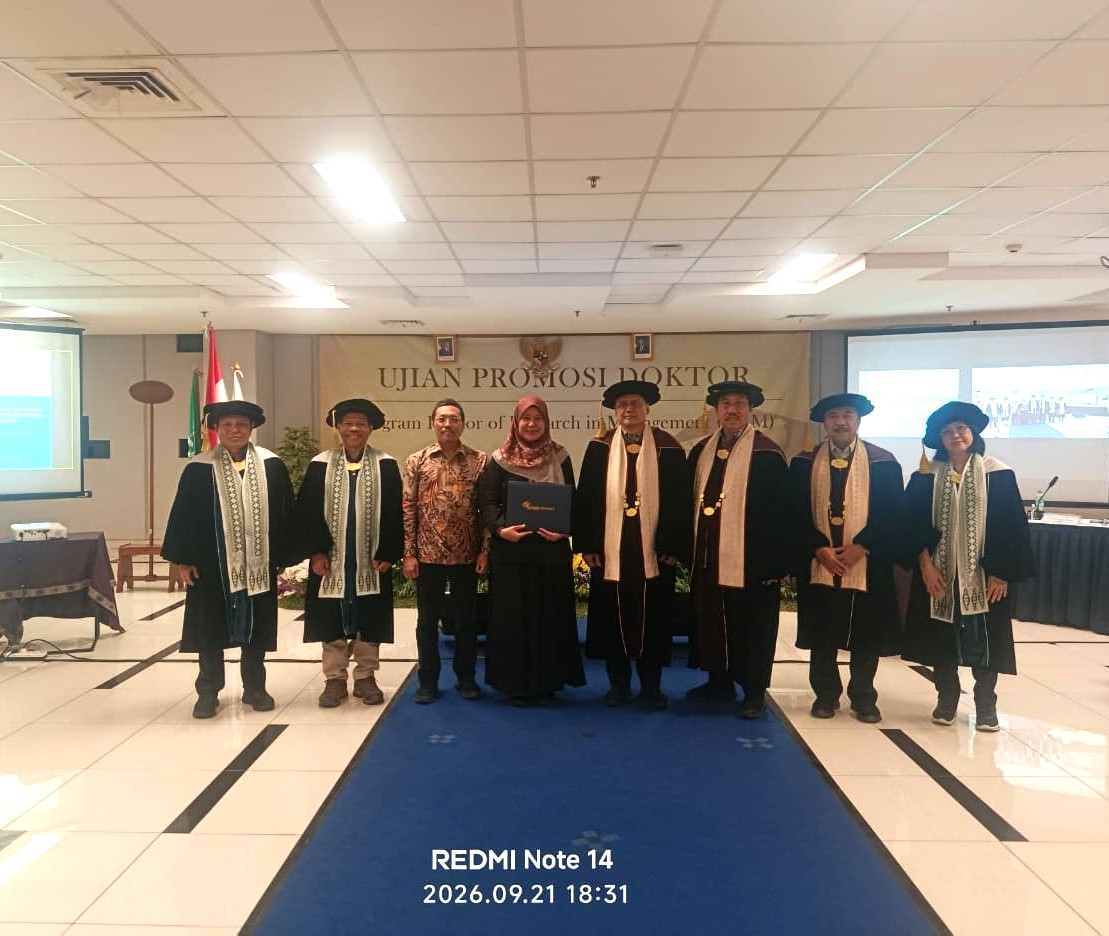
On Thursday, 21 September 2026, The Dissertation Defense for the Doctor of Research in Management (DRM) program of SYAHDA SUKMA INDIRA [2440127400], entitled “The Effect of Entrepreneurial Leadership, Knowledge Management and Digital Capability on Entrepreneurial Performance Mediated by Value Cocreation on Junior High School in Indonesiae,” was conducted at Room B0301, BINUS @Alamsutera Campus
The dissertation defense was chaired by Prof. Dr. Engkos Achmad Kuncoro, S.E, M.M., who served as the chair of the examination committee and an examiner. The session was also attended by the supervisory committee and the board of examiners, who provided academic evaluation and feedback on the dissertation presented. The supervisory committee consisted of Prof. Dr. Ir. Sasmoko, M.Pd., M.A., CIRR, IPU, ASEAN Eng., SMIEEE, as the Promoter (Supervisor), accompanied by Agustinus Bandur, Ph.D as Co-Promoter I, and Dr. Yosef Dedy Pradipto L.Th., M.Hum., M.Si. , as Co-Promoter II. Meanwhile, the board of examiners comprised Prof. Dr. Mts. Arief, M.M., MBA., CPM, as Examiner I and Dr. Hartiwi Prabowo, S.E., M.M. as Examiner II and Prof. Dr. Budiyanto, M.S, M.M as Examiner III
During the defense, the supervisors and examiners raised various questions, provided constructive feedback, and conducted a comprehensive academic evaluation to assess the depth of the research and the scholarly contribution of the dissertation.
Dissertation Summary
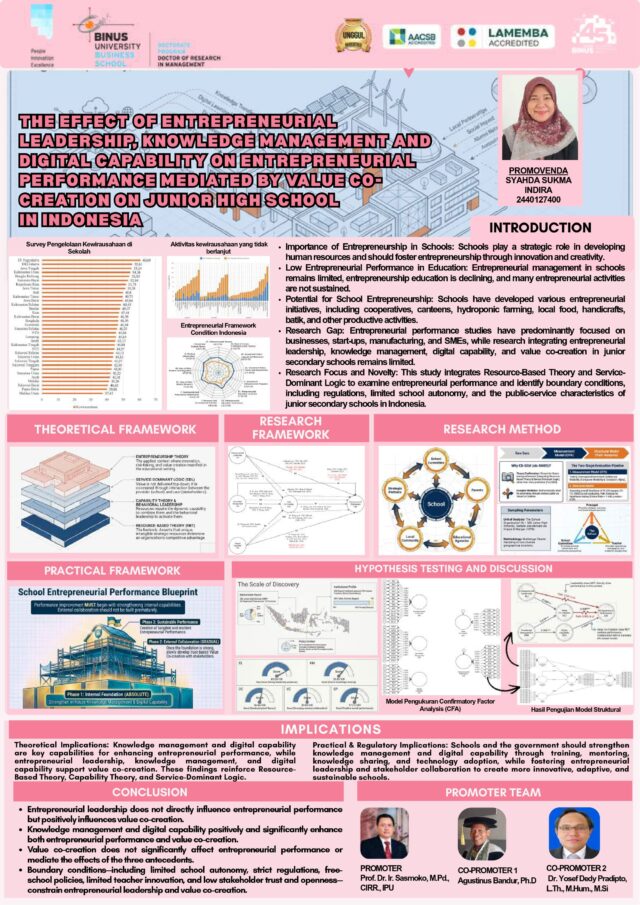
This study was motivated by the need to transform schools into innovative and entrepreneurial educational organizations. Although entrepreneurship development has become a key responsibility of school principals, significant challenges remain in strengthening entrepreneurial capacity in Indonesian schools. To address this research gap, the study examines the effects of entrepreneurial leadership, knowledge management, and digital capability on school entrepreneurial performance, with value co-creation serving as a mediating variable.
Using a quantitative approach involving 380 junior high schools (SMPs) across Indonesia and analyzed through Covariance-Based Structural Equation Modeling (CB-SEM), the study found that knowledge management and digital capability are the most important factors in improving schools’ entrepreneurial performance. Both capabilities also played a significant role in fostering value co-creation, defined as a collaborative process between schools and stakeholders to create shared value.
The findings further reveal that entrepreneurial leadership contributes positively to value co-creation but does not have a direct, significant effect on entrepreneurial performance. Moreover, although entrepreneurial leadership, knowledge management, and digital capability influence value co-creation, value co-creation does not significantly affect entrepreneurial performance. In other words, value co-creation has not yet become an effective mechanism for translating leadership and organizational capabilities into improved entrepreneurial performance in schools.
The study also identifies several boundary conditions that are unique to the context of Indonesian junior high schools. Factors such as limited school autonomy, strong regulatory and administrative controls, free education policies, limited innovation capacity among educators, and insufficient communication, trust, and openness among stakeholders hinder the effective translation of co-created value into improved school performance.
Overall, the study concludes that strengthening knowledge management and digital capability as core internal organizational foundations more effectively enhances school entrepreneurial performance. Meanwhile, entrepreneurial leadership plays an important role in creating an environment that supports collaboration, organizational learning, communication, and stakeholder engagement. The study also makes a theoretical contribution by demonstrating that the relationships among entrepreneurial leadership, organizational capabilities, value creation, and performance are highly context-dependent. Consequently, the effectiveness of value co-creation depends significantly on organizational readiness and the institutional conditions in which it is implemented.
Authours Biography
Syahda Sukma Indira is a professional in educational management and policy with more than two decades of experience as a civil servant at the Ministry of Education. She earned her Bachelor’s Degree in Communication Science from Gadjah Mada University in 2001 and her Master’s Degree in Public Administration from the University of Indonesia in 2010. She is currently pursuing a doctoral degree in the Doctor of Research in Management (DRM) program at BINUS Business School, with research interests focusing on management, leadership, innovation, and entrepreneurship in the education sector.
Throughout her career, Syahda Sukma Indira has contributed to strategic areas related to policy development, program planning and implementation, quality improvement, and strengthening educational governance. Her experience at the Directorate of Junior High Schools (SMP) includes involvement in the formulation and implementation of basic education policies, the development of the 9-Year and 13-Year Compulsory Education Programs, initiatives addressing Out-of-School Children (OSC), learning innovation and transformation, and the enhancement of collaboration among central and local governments, educational institutions, and other key stakeholders.
Currently, she serves at the Directorate of Early Childhood Education (PAUD), focusing on educational infrastructure development, establishing New School Units (USB), revitalizing early childhood education institutions, providing Educational Play Equipment (APE), strengthening governance, and conducting program monitoring and evaluation. These experiences have given her a comprehensive understanding of the entire educational policy process, from formulation to implementation at the national level.
In addition to her role as a public policy practitioner, Syahda Sukma Indira is also an active researcher and academic. Her research interests include entrepreneurial leadership, knowledge management, digital capability, value co-creation, and entrepreneurial performance in educational contexts. Her research has been published in international scientific journals and presented at various national and international academic conferences.
Combining her experience as a government official, practitioner, and researcher, Syahda Sukma Indira is strongly committed to advancing evidence-based educational policymaking, strengthening governance and institutional capacity in the education sector, fostering strategic partnerships among stakeholders, and promoting innovative leadership to enhance the quality, equity, and competitiveness of education in pursuit of high-quality education for all.
Publication
During his doctoral studies in the DRM programme, he has successfully published two internationally recognised scholarly articles, namely:
Paper title: The Role of Entrepreneurial Leadership, Knowledge Management, and Digital Capability in Enhancing Entrepreneurial Performance and Value Co-Creation in the Education Sector
Journal Name: Administrative Sciences (MDPI)
Link: https://www.mdpi.com/2076-3387/15/12/462
Paper title: Business perspectives on value co-creation as a mediator for entrepreneurial performance in educational contexts
Journal Name: International Journal of Business Innovation and Research
Link: https://www.inderscienceonline.com/doi/abs/10.1504/IJBIR.2026.152515