

Dissertation Examination of Ade Prasetia
Introduction
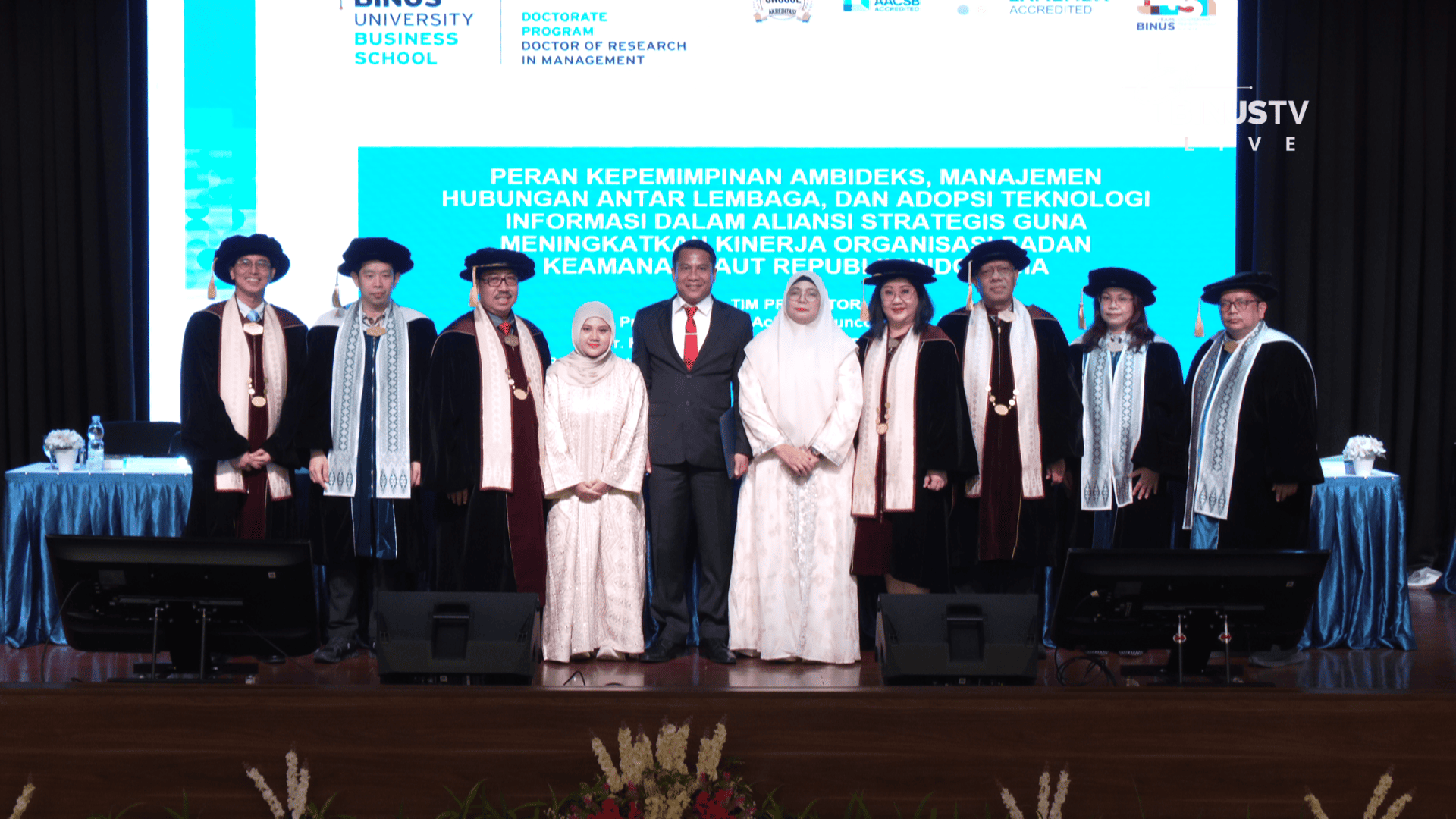
On Thursday, 23 April 2026, The Dissertation Defense for the Doctor of Research in Management (DRM) program of Ade Prasetia [2540136228], entitled “The Roles of Ambidextrous Leadership, Inter Organizational Relation Management, and Information Technology Adoption in Strategic Alliance for Increasing Indonesian Maritime Security Agency Organizational Peformance” was conducted at Auditorium 4th floor, Anggrek Campus, Kemanggisan, West Jakarta.
The dissertation defense was chaired by Prof. Dr. Lim Sanny, S.T., M.M. who served as the chair of the examination committee as well as an examiner. The session was also attended by the supervisory committee and the board of examiners, who provided academic evaluation and feedback on the dissertation presented. The supervisory committee consisted of Prof. Dr. Engkos Achmad Kuncoro, S.E, M.M. as the Promoter (Supervisor), accompanied by Dr. Rano Kartono, B.I.T., M.Buss (MIS)., CERA as Co-Promoter I and Prof. Gatot Soepriyanto, S.E., Ak., M.Buss (Acc)., Ph.D., CA, CFE. Meanwhile, the board of examiners comprised Prof. Dr. Ir. Mohammad Hamsal, MSE., MQM., MBA. as Examiner I and Evelyn Hendriana, S.E.,, M.Si., Ph.D. as Examiner II and Dr. Hally Hanafiah, CSCA, CSCM, CPLM as Examiner III
During the defense, the supervisors and examiners raised various questions, provided constructive feedback, and conducted a comprehensive academic evaluation to assess the depth of the research and the scholarly contribution of the dissertation.
Dissertation Summary
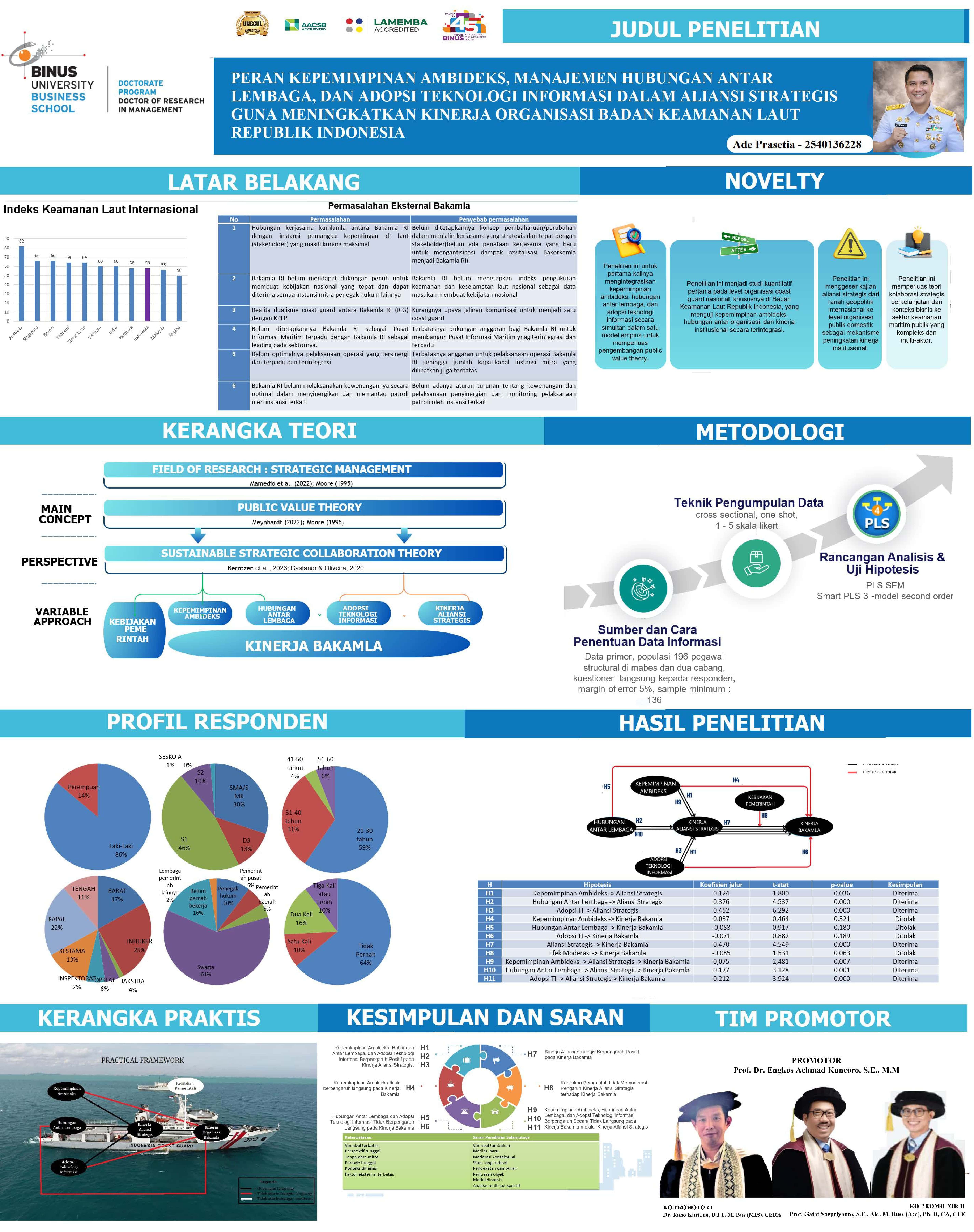
Based on the findings of this study, it can be concluded that the improvement of organizational performance within the Badan Keamanan Laut Republik Indonesia is highly influenced by the effectiveness of inter-agency strategic alliance performance. Ambidextrous leadership, inter-agency relationships, and information technology adoption were found to have a positive and significant impact on the establishment of effective strategic alliances. These findings indicate that Bakamla’s success in carrying out its maritime security functions depends not only on the organization’s internal capabilities, but also on its ability to build synergistic collaboration with various maritime security stakeholders.

This study also demonstrates that ambidextrous leadership plays a significant role in improving organizational performance, both directly and indirectly through strategic alliance performance. Leaders who are capable of balancing exploration and exploitation orientations are considered more effective in addressing the complexities of national maritime security coordination. Furthermore, inter-agency relationships and information technology adoption were proven to enhance organizational performance indirectly through the strengthening of strategic alliances, although both variables did not have a direct effect on Bakamla’s organizational performance.
Moreover, strategic alliance performance was found to be a key factor mediating the relationship between the independent variables and organizational performance. This finding emphasizes that the effectiveness of coordination, information integration, and synergy among maritime security stakeholders constitutes the primary foundation for improving the quality of Bakamla’s operational performance. Therefore, the organization’s success in safeguarding national maritime security and safety is largely determined by its ability to establish effective and sustainable strategic cooperation.
On the other hand, the quality of government policy was not proven to moderate the relationship between strategic alliance performance and organizational performance. This finding suggests that the existence of formal policies alone is insufficient to strengthen organizational effectiveness without consistent implementation, strong inter-agency coordination, and concrete operational support. Therefore, this study provides important implications for the development of national maritime security governance, particularly in supporting the establishment of a more integrated, effective, and public value-based national coast guard system.
Author Biography
Ade Prasetia is a Rear Admiral of the Indonesian Navy who graduated from the Indonesian Naval Academy (AAL) in 1998 and continued his Officer Candidate Education (Dikpasis) in 1999. In addition to his military career, he is also recognized as an academic. In 2001, he pursued his undergraduate studies in Marine and Fisheries Science at Hasanuddin University. He later completed his postgraduate education at Indonesia Defense University in 2013, majoring in Disaster Management for National Security. Currently, he is pursuing doctoral studies in Research and Management at BINUS University.
His strong interest in maritime affairs has encouraged him to actively write and develop strategic ideas related to maritime issues. Throughout his military career, Rear Admiral Ade Prasetia has held various important assignments within the Indonesian Navy, including positions at the Eastern Fleet Command (Koarmatim), Western Fleet Command (Koarmabar), Military Sealift Command (Kolinlamil), Maritime Studies Center (Pusjianmar), and aboard several Indonesian Navy warships (KRI). He has also served at the Indonesian Maritime Security Agency and the State Intelligence Agency Indonesia.
At present, Rear Admiral Ade Prasetia serves as Senior Expert Staff Officer Level II for Socio-Cultural Affairs, Law, Human Rights, and Narcotics to the Commander of the Indonesian National Armed Forces (TNI).
Publication
During his studies in the Doctoral Program in Management Science, several of his research publications have been published in reputable international journals.
Title: Organizational Performance of Indonesia’s Maritime Security Agency: A Case Study on Maritime Security Coordination
Journal: TPM – Testing, Psychometrics, Methodology in Applied Psychology
Link: https://www.tpmap.org/search-view/?search=ade+prasetia
Title: Coast Guard’s performance: Impacts of interorganizational relations and IT adoptions
Journal: Maritime Technology and Research
Link: https://so04.tci-thaijo.org/index.php/MTR/article/view/281541