

Dissertation Examination of Avioko Leksiantoro

Introduction
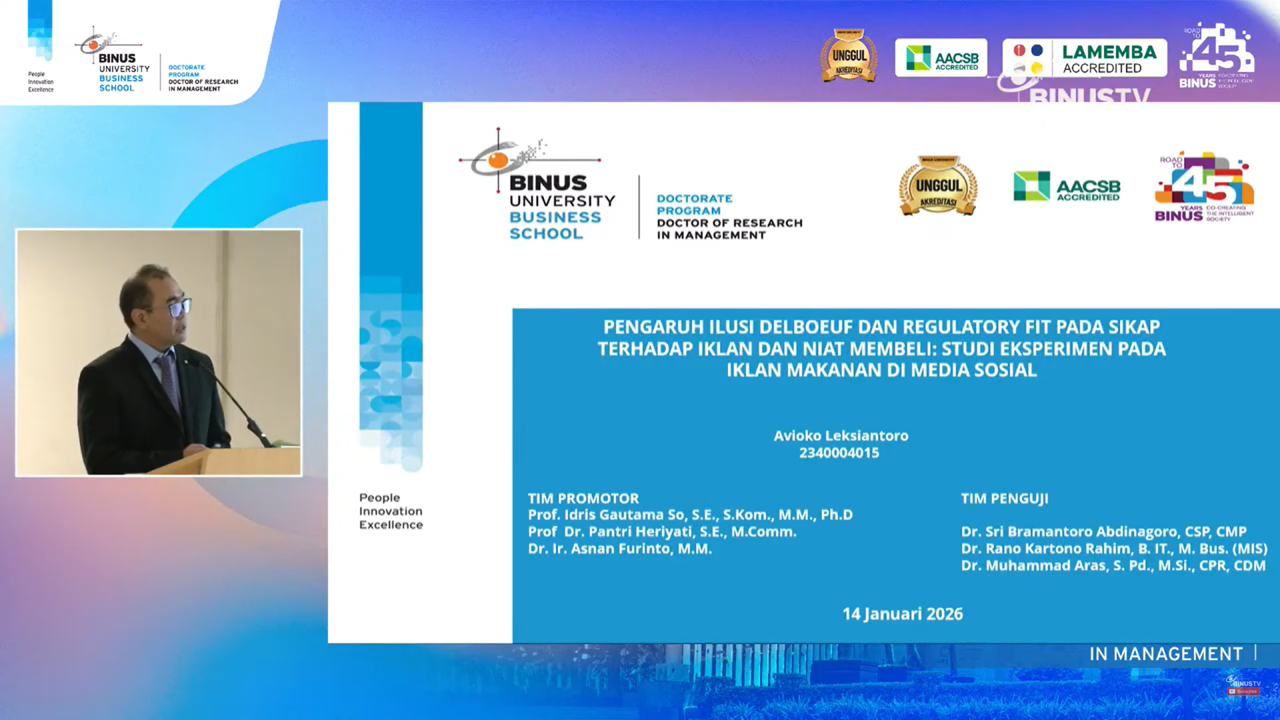
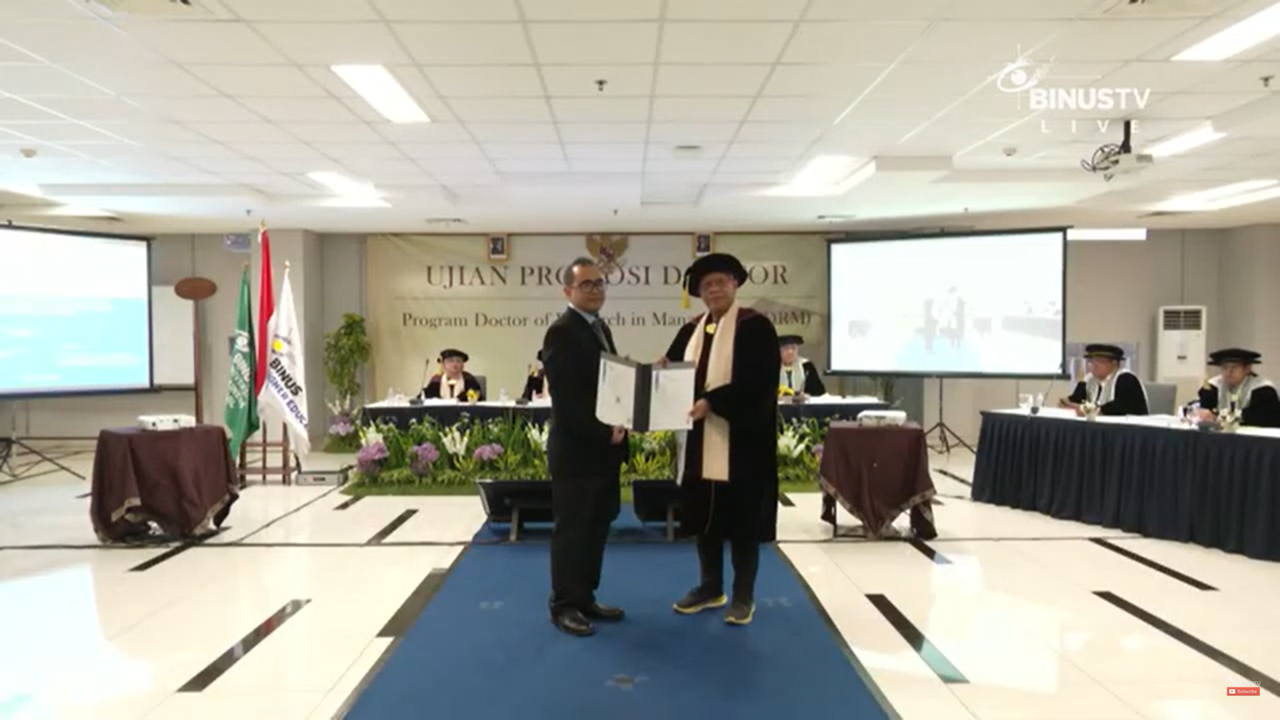
On Thursday, 25 Juni 2026, The Dissertation Defense for the Doctor of Research in Management (DRM) program of Avioko Leksiantoro [2340004015], entitled “The Impact of Delboeuf Illusion and Regulatory Fit on Attitude Toward Advertising and Purchase Intention: an Experimental Study of Food Advertising in Social Media” was conducted at Room B0301 3rd Floor Alam Sutera Campus, Bina Nusantara University, South Tangerang.
The dissertation defense was chaired by Prof. Dr. Ir. Mohammad Hamsal, MSE., MQM., M.B.A., CISCP, CPOD, CSP who served as the chair of the examination committee as well as an examiner. The session was also attended by the supervisory committee and the board of examiners, who provided academic evaluation and feedback on the dissertation presented. The supervisory committee consisted of Prof. Idris Gautama So, S.E., S.Kom., M.M., Ph.D. as the Promoter (Supervisor), accompanied by Prof. Dr. Pantri Heriyati, S.E., M.Comm. as Co-Promoter I and Dr. Asnan Furinto, S.T., M.M. as Co-Promotor II. Meanwhile, the board of examiners comprised Dr. Sri Bramantoro Abdinagoro, CSP, CMP as Examiner I and Dr. Rano Kartono, B.I.T., M.Buss (MIS)., CERA as Examiner II and Dr. Muhammad Aras, S. Pd., M.Si., CPR, CDM as Examiner III
During the defense, the supervisors and examiners raised various questions, provided constructive feedback, and conducted a comprehensive academic evaluation to assess the depth of the research and the scholarly contribution of the dissertation.
Dissertation Summary
The culinary industry is one of the sectors that significantly contributes to Indonesia’s economy, accounting for 6.61% of the country’s Gross Domestic Product (GDP). As the use of social media as a promotional platform continues to increase among food and beverage businesses, developing effective advertising strategies that attract consumers and stimulate purchase intentions has become increasingly important. This study examines the effectiveness of social media advertising design by integrating the Delboeuf illusion, regulatory focus, and message framing while considering consumers’ perceived quality uncertainty.
This research adopts a consumer behavior perspective grounded in marketing psychology and employs a quantitative experimental approach consisting of three interrelated experiments. The variables examined include plate size (large vs. small), regulatory focus (promotion focus vs. prevention focus), message framing (gain-framed vs. loss-framed), and perceived quality uncertainty. The effects of these variable combinations were evaluated through consumers’ attitudes toward advertisements and their purchase intentions.
The findings indicate that consumers with a promotion focus respond more positively to advertisements featuring small plates, whereas consumers with a prevention focus show more favorable responses to large plates. Advertising effectiveness increases when regulatory fit is achieved, meaning that the visual elements are aligned with the advertising message. Specifically, the combination of small plates and gain-framed messages generates more positive attitudes toward advertisements and stronger purchase intentions, while large plates combined with loss-framed messages are more effective for consumers with a prevention focus. Under conditions of high perceived quality uncertainty, such as with new restaurants or unfamiliar products, the combination of small plates and gain-framed messages is the most effective in encouraging consumers to try new products. Conversely, under conditions of low perceived quality uncertainty, the combination of large plates and loss-framed messages produces better outcomes.
The novelty of this study lies in integrating the Delboeuf illusion, regulatory focus, and message framing into a single research model while incorporating perceived quality uncertainty as a contextual variable. These findings contribute to the advancement of consumer behavior theory and provide practical implications for culinary businesses, particularly small and medium-sized enterprises (SMEs), in designing more effective and efficient social media advertisements to enhance consumer engagement and increase sales.
Author Biography
Avioko Leksiantoro earned his Bachelor’s degree in Mechatronics from Swiss German University before pursuing a Master of Business (Master of Management) at Universitas Gadjah Mada. He is currently pursuing a doctoral degree at BINUS Business School.
He is a professional and entrepreneur with more than 15 years of experience across the information technology, manufacturing, automotive, and business management industries. Throughout his career, Avioko has played a key role in collaborative projects with Nissan Japan to develop Standard Operating Procedures (SOPs) and design operational systems for Nissan workshops throughout Indonesia.
His expertise in continuous improvement, particularly in Kaizen and 5S methodologies, earned him First Place in the Kaizen Competition within the Indomobil Group. Building on this experience, he has consistently developed innovative systems aimed at improving operational efficiency, service quality, and business profitability. His professional credentials are further strengthened by various certifications in leadership, finance, and business strategy.
Currently, Avioko manages and develops businesses in the food and beverage (F&B) and automotive sectors as an entrepreneur. With extensive managerial experience, he possesses expertise in business development strategy, market expansion, cross-functional team management, and the use of data analytics to understand consumer behavior and market trends. His passion for Kaizen continues to inspire him to build innovative, adaptive, and sustainable business systems that drive long-term organizational growth.