

Dissertation Examination of Endang Kariasih
Introduction
On Monday, 25 Mei 2026, The Dissertation Defense for the Doctor of Research in Management (DRM) program of Endang Kariasih [2340004223], entitled “The Effect of Ambidextrous Leadership, Competency of Lectures and Educational Staff, and External Partner Collaboration on Performance Through Innovation That is Moderated by Technology Capabilities at Private Colleges in Jakarta” was conducted at Room B0301 3rd Floor Alam Sutera Campus, Bina Nusantara University, South Tangerang.
The dissertation defense was chaired by Prof. Dr. Engkos Achmad Kuncoro, S.E, M.M who served as the chair of the examination committee as well as an examiner. The session was also attended by the supervisory committee and the board of examiners, who provided academic evaluation and feedback on the dissertation presented. The supervisory committee consisted of Prof. Dr. Mts. Arief, M.M., MBA., CPM. as the Promoter (Supervisor), accompanied by Prof. Dezie Leonarda Warganegara, Ph.D as Co-Promoter I and Dr. Sri Bramantoro Abdinagoro, CSP, CMP as Co-Promotor II. Meanwhile, the board of examiners comprised Agustinus Bandur, Ph.D as Examiner I and Prof. Dr. Ir. Mohammad Hamsal, MSE., MQM., M.B.A., CISCP, CPOD. as Examiner II and Prof. Dr. Endang Sulistya Rini SE., M.Si as Examiner III
During the defense, the supervisors and examiners raised various questions, provided constructive feedback, and conducted a comprehensive academic evaluation to assess the depth of the research and the scholarly contribution of the dissertation.
Dissertation Summary
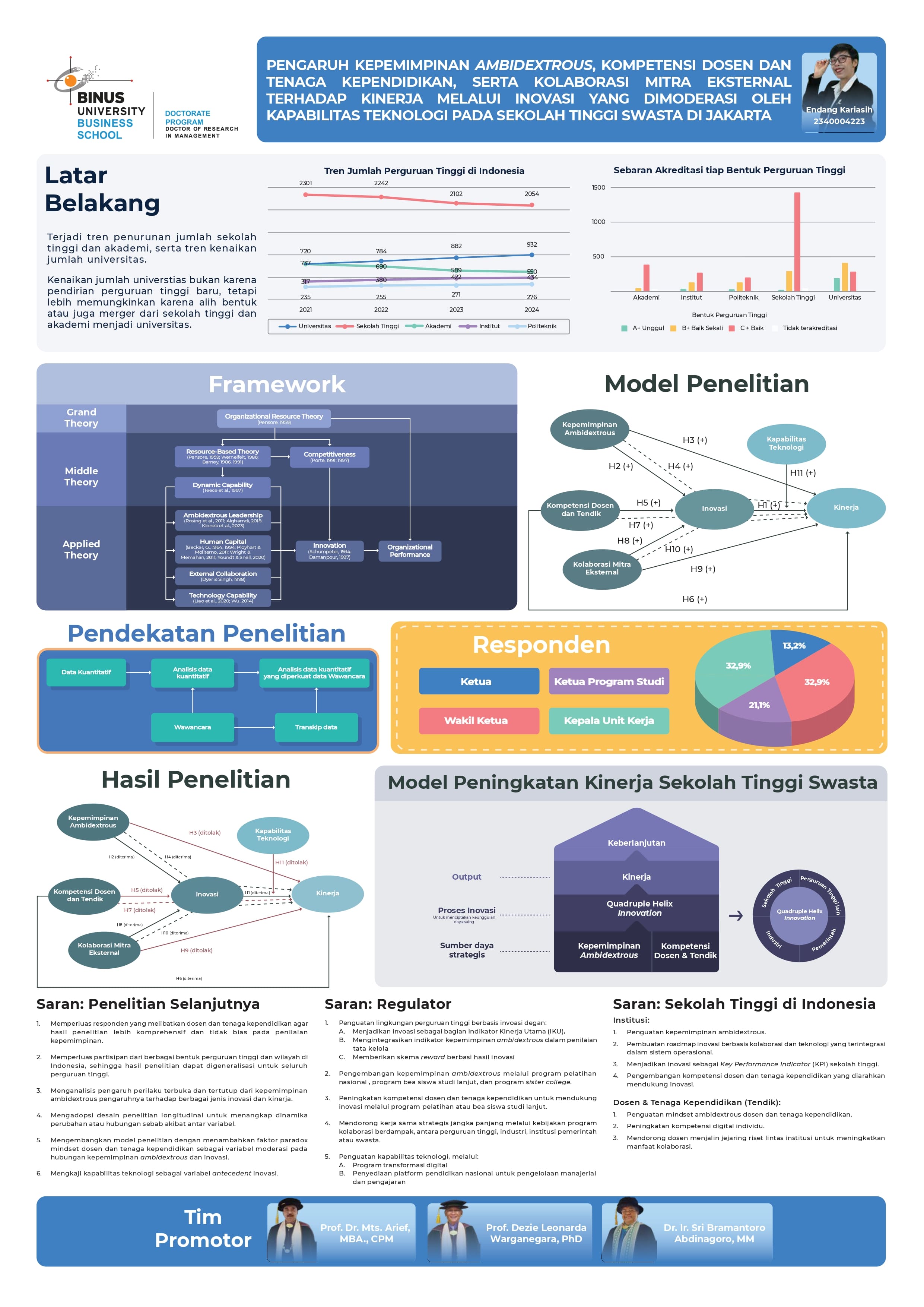
This study demonstrates that the performance improvement of private higher education institutions, particularly colleges under the jurisdiction of LLDikti Region III Jakarta, is largely determined by their ability to create and manage innovation in a sustainable manner. Innovation emerged as the most dominant factor in enhancing organizational performance while simultaneously serving as a strategic mechanism that links internal and external resources to institutional performance outcomes.
The findings indicate that ambidextrous leadership is the strongest driver of innovation, followed by external partner collaboration. Leadership that effectively balances the exploration of new opportunities with the exploitation of existing resources has been proven to foster innovation that positively influences organizational performance. Although the direct effect of ambidextrous leadership on performance was found to be negative and significant, it continues to contribute positively through the innovation it generates. This finding suggests that a leadership orientation emphasizing change, experimentation, and long-term development may produce short-term operational consequences, yet yields greater strategic benefits in the long run. Accordingly, innovation serves as a competitive mediator in the relationship between ambidextrous leadership and organizational performance.
The study also found that the competencies of academic and administrative staff contribute directly to the performance of higher education institutions. High levels of competence support the effective execution of academic and administrative responsibilities, thereby improving organizational outcomes. However, these competencies were not found to significantly stimulate innovation or enhance performance through innovation. This suggests that individual competencies have not yet been fully transformed into organizational innovative capacity.
Furthermore, external partner collaboration was identified as a significant driver of innovation. Collaboration with government agencies, industry partners, communities, and other educational institutions expands access to resources, knowledge, technology, and development opportunities that facilitate innovation. Although such collaboration does not exert a significant direct effect on organizational performance, it enhances performance indirectly through the innovation it generates. Therefore, innovation functions as a full mediator in the relationship between external partner collaboration and organizational performance.
On the other hand, technological capability was not found to strengthen the relationship between innovation and performance. This finding indicates that the technological maturity of most colleges remains insufficient to maximize the benefits of innovation in improving organizational performance. In other words, technology has not yet functioned effectively as an enabling factor capable of converting innovation outcomes into higher levels of performance.
Overall, this study highlights that improving the performance of private higher education institutions depends not only on the quality of internal resources but also on the institution’s ability to develop an innovation ecosystem that engages multiple external stakeholders. These findings support the relevance of the Quadruple Helix Innovation model as an approach to enhancing institutional competitiveness and sustainability. Within this model, ambidextrous leadership and the competencies of academic and administrative staff serve as key strategic resources, while collaboration with government, industry, academia, and society acts as a catalyst for accelerating innovation. Through the synergy of internal resources, external collaboration, and organizational innovation capacity, private higher education institutions can achieve superior, adaptive, and sustainable performance amid the increasingly competitive landscape of higher education.
Author Biography
Endang Kariasih, S.Si., M.Si. obtained her Bachelor of Science degree in 2003 and Master of Science degree in 2006 from the Department of Physics at Universitas Gadjah Mada. With a strong foundation in science, she began her professional career at Stella Maris School, where she worked in the Research and Development Division from 2006 to 2010. In 2010, she joined BPK PENABUR Jakarta as a Science Expert in the Curriculum and Evaluation Unit, and in 2015, she was assigned to the Research and Development Unit. Since 2021, she has been serving as the Head of Quality Assurance at BPK PENABUR Jakarta. In this role, she oversees the development of strategic plans, ensures their implementation through institutional programs, and evaluates their outcomes. She also ensures that operational management systems are aligned with established standard operating procedures and that the quality of educational services is consistently maintained.
Publication
During his studies in the Doctoral Program in Management Science, several of his research publications have been published in reputable international journals.
1. Kariasih, E., Arief, M., Warganegara, D. L., & Abdinagoro, S. B. (2026). The Impact of Ambidextrous Leadership and External Collaboration on Innovation and Performance of Private Higher Education. Journal of Educational and Social Research, 16.
2. Kariasih, E., Arief, M., Warganegara, D. L., & Abdinagoro, S. B. (2026). The Role of Ambidextrous Leadership in Driving Innovation and Organizational Performance in Private Higher Education. International Journal of Management in Education.