

Dissertation Examination of Judi Arto
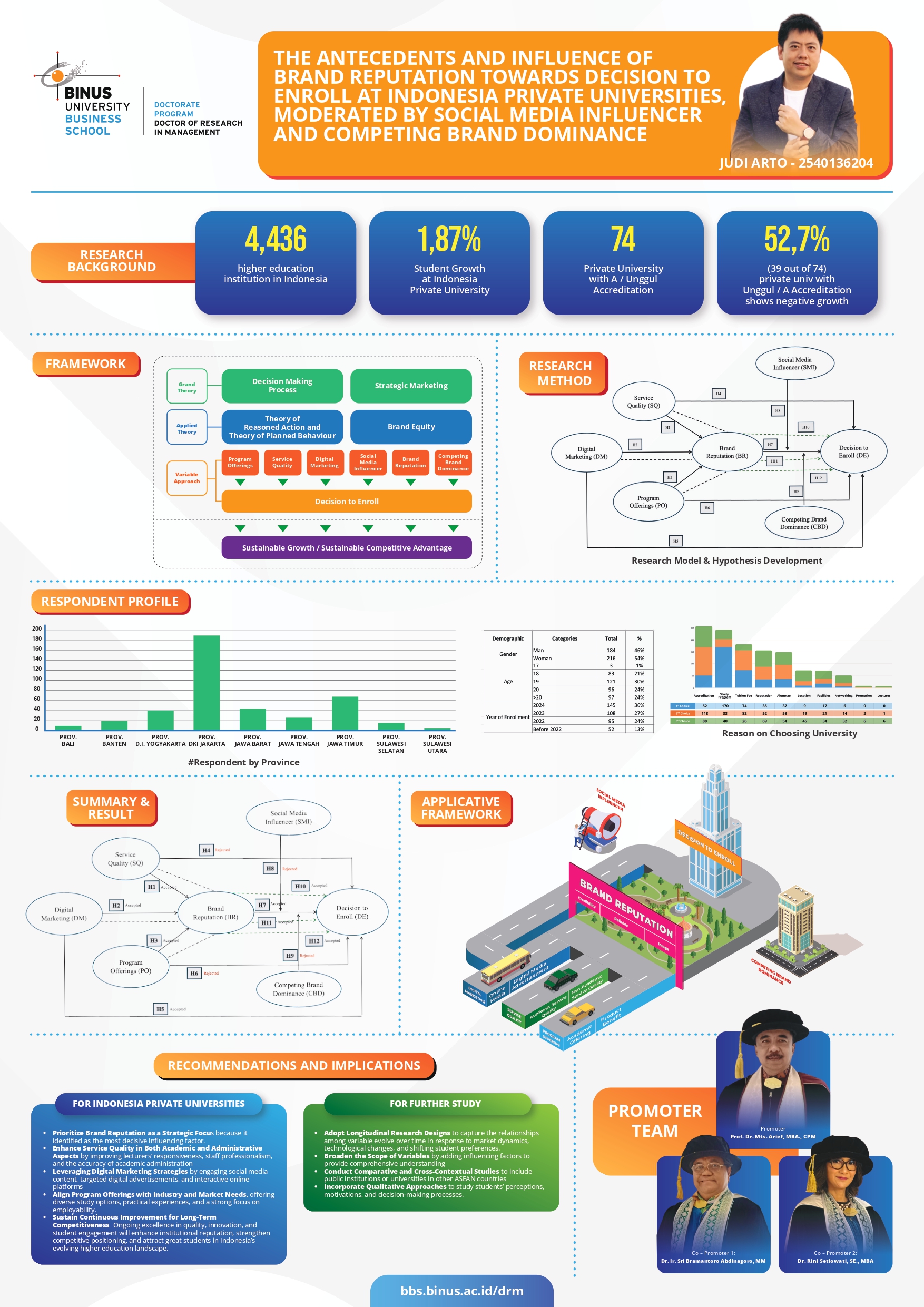
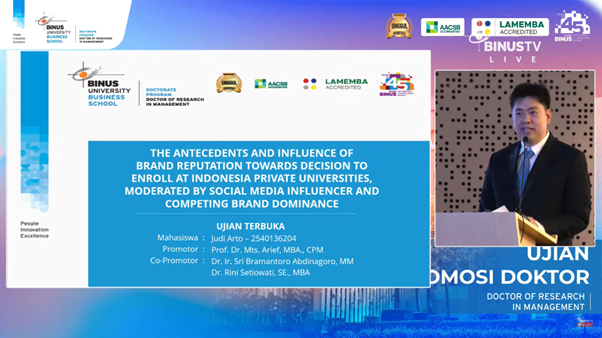
On Wednesday, 4 March 2026, The Dissertation Defense for the Doctor of Research in Management (DRM) program of Judi Arto [2540136204], entitled “The Antecedents and Influence of Brand Reputation Towards Decision to Enroll at Indonesia Private Universities, Moderated by Social Media Influencer and Competing Brand Dominance,” was conducted at the Auditorium 4th floor, Bina Nusantara University, Anggrek Campus
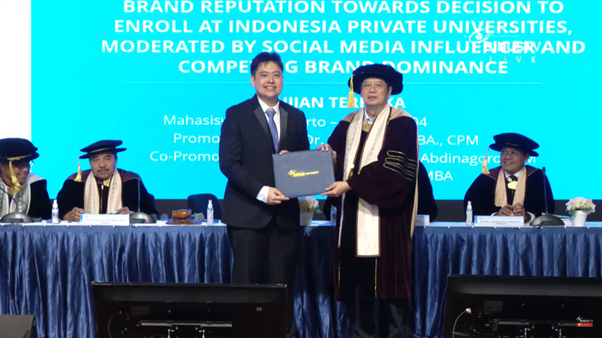
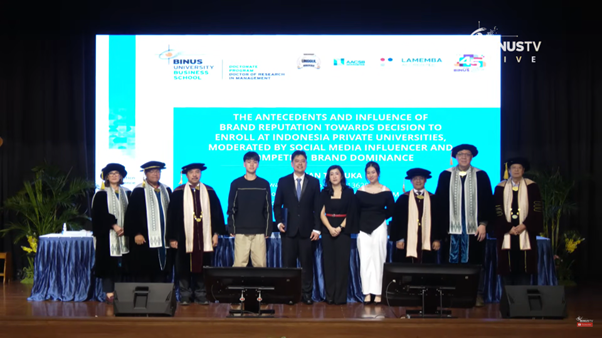
The dissertation defense was chaired by Prof. Dr. Ir. Harjanto Prabowo, M.M., who served as the chair of the examination committee as well as an examiner. The session was also attended by the supervisory committee and the board of examiners, who provided academic evaluation and feedback on the dissertation presented.
The supervisory committee consisted of Prof. Dr. Mts. Arief, M.M., M.B.A., CPM as the Promoter (Supervisor), accompanied by Dr. Sri Bramantoro Abdinagoro as Co-Promoter I and Dr. Rini Setiowati, S.E., M.B.A. as Co-Promoter II. Meanwhile, the board of examiners comprised Dr. Asnan Furinto, S.T., M.M. as Examiner I and Prof. Dr. Ir. Agustinus Purna Irawan, M.T., M.M., IPU., ASEAN Eng as Examiner II.
During the defense, the supervisors and examiners raised various questions, provided constructive feedback, and conducted a comprehensive academic evaluation to assess the depth of the research and the scholarly contribution of the dissertation.
Dissertation Summary
This study concludes that brand reputation plays a central and decisive role in influencing students’ enrollment decisions at private universities in Indonesia. In an increasingly competitive higher education landscape, where the number of private institutions continues to grow while several top accredited universities experience negative enrollment growth, institutional reputation becomes a critical strategic asset.
The findings demonstrate that service quality, digital marketing, and program offerings significantly contribute to strengthening brand reputation. High lecturer competence, responsive administrative services, well-maintained facilities, and effective problem-solving capabilities reinforce institutional credibility and trust. Likewise, strong digital marketing strategies through informative websites, engaging social media presence, and targeted online campaigns enhance visibility and emotional connection with prospective students. Program offerings that are industry-relevant, innovative, and supported by internships, international collaboration, and strong alumni outcomes also reinforce the institution’s academic image and long-term value.
However, the study reveals that service quality and program offerings do not directly influence students’ enrollment decisions during the selection stage. Prospective students tend to prioritize factors such as institutional reputation, academic prestige, financial considerations, and career prospects when choosing a university. Service quality tends to become more influential after students enroll, contributing to satisfaction and institutional loyalty rather than initial decision-making.
In contrast, digital marketing has a direct and significant effect on enrollment decisions, as it shapes perceptions, provides accessible information, and reduces uncertainty among prospective students. A strong digital presence helps convert student interest into actual enrollment, particularly in an environment where Indonesian students are highly active online.
Furthermore, brand reputation is confirmed as the most influential factor affecting enrollment decisions, serving as a signal of academic quality, credibility, and long-term career opportunities. Students and parents rely heavily on institutional reputation as a heuristic to reduce perceived risk when selecting a university.
The study also finds that social media influencers do not significantly moderate the relationship between brand reputation and enrollment decisions, indicating that higher education decisions remain high-involvement choices where credibility and academic excellence outweigh promotional endorsements. Similarly, the dominance of public universities does not significantly weaken the influence of private university brand reputation, suggesting that private institutions can remain competitive by building strong differentiation through specialized programs, industry collaboration, and personalized educational experiences.
Overall, the study highlights that a strong and credible brand reputation supported by academic excellence, effective digital engagement, and high-quality institutional services is essential for private universities to remain competitive and sustain student enrollment in Indonesia’s evolving higher education environment.
Author Biography
Judi Arto, S.T., M.M., is a dedicated Doctor of Research in Management (DRM) student at BINUS Business School. He has a background in Industrial Engineering from BINUS University and a master’s degree in management from BINUS Business School. He has over two decades of practical experience in various roles within BINUS Group, including his current position as Marketing Director. He oversees and manages both BINUS’ marketing and admission function as well as Corporate & Marketing Communication from Pre – School program to Doctorate Degree. Currently, BINA NUSANTARA has successfully developed more than 20 campuses and educated 50.000+ active students in Indonesia. Judi is also a faculty member at BINUS UNIVERSITY and Head of School of Leadership at BINUS Corporate & Learning Development.
Publication
His recent publications during his doctoral program includes:
- Brand Reputation Role and Social Media Influencer Moderation in Making Decision to Enroll to Indonesian Private Universities
- Why do Students Enroll at Top Private Universities? A Study of Brand Reputation Towards Decision to Enroll at Indonesia Private Universities with A Accreditation
- Brand Reputation and Student Decision – Making in Higher Education: A Systematic Literature Review (2021 – 2025)