

Dissertation Examination of Sari Apriza
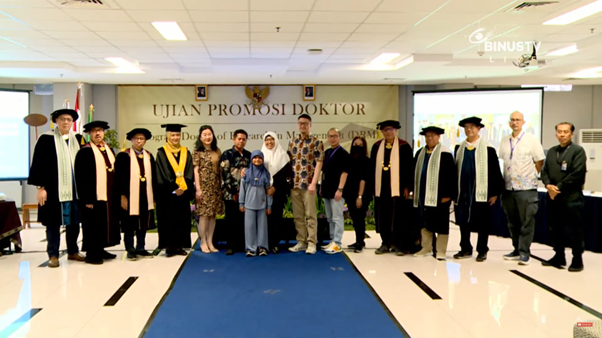
On Thursday, 18 December2025, The Dissertation Defense for the Doctor of Research in Management (DRM) program of Sari Apriza [2440127344], entitled “Enhancing Partnership Performance of Medical Clinics in Indonesia” was conducted at Anggrek Campus, Bina Nusantara University, West Jakarta.
The Dissertation Defense was chaired by Prof. Dr. Ir. Mohammad Hamsal, MSE, MQM, MBA, supervised and examined by Prof. Engkos Achmad Kuncoro, S.E., M.M (Promotor), Prof. Ir. Firdaus Alamsjah, M.Sc., Ph.D (Co-Promoter 1), Dr. Asnan Furinto, S.T., M.M., MBA (Co-Promoter II). The Board of Examiners also included DR. dr. Sutoto Cokro. M.Kes- FISQua (Examiner I), and Assoc. Prof. Dr. Ir. Sri Bramantoro Abdinagoro, MM., CBV., CMP (Examiner II) and Prof. Dr. Yolanda Masnita Siagian, CIRR, CMA, CPM (Asia) (Examiner III)

Dissertation Summary
The purpose of this study is to examine the effect of the strategic capabilities of private healthcare clinics in Indonesia on B2B partnership performance, while taking into account the dynamics of Indonesia’s unique healthcare service ecosystem, particularly within a sector characterized by resource constraints and limited connectivity due to Indonesia’s demographic characteristics as an archipelagic country. Using a quantitative approach with a descriptive and explanatory survey design, primary data were collected from 370 clinic managers across Indonesia. Respondents were selected through random sampling to ensure the generalizability of the findings. The data were analyzed using Partial Least Squares Structural Equation Modeling (PLS-SEM) to measure constructs and test the proposed hypotheses.


The results indicate that intrapreneurship capability (β = 0.173; p = 0.002) and partnership capability (β = 0.219; p = 0.000) have a significant positive effect on partnership performance. Collectively, the model explains 65.2% of the variance in partnership performance. However, the findings reveal that network capability does not have a significant direct effect on partnership performance (β = 0.105; p = 0.099), nor does relationship quality exhibit a significant direct effect (β = 0.082; p = 0.107).
The study further highlights a weak mediating role, and shows that the healthcare service ecosystem exerts a negative moderating effect on partnership performance (β = −0.067; p = 0.029). Accordingly, clinic managers are encouraged to invest in internal capabilities, such as intrapreneurship and partnership capability, while leveraging internal resources as network collaborators. From an interorganizational theory perspective, the findings suggest that the unique characteristics of Indonesia’s healthcare ecosystem may weaken mediating mechanisms that are typically considered strong, thereby underscoring the need to prioritize the development of multisectoral B2B partnerships. In this regard, policymakers can play a critical role in supporting initiatives aimed at strengthening healthcare service networks holistically among stakeholders within the healthcare ecosystem.

Author Biography
Sari Apriza is a student in the Doctor of Research in Management (DRM) program, specializing in Entrepreneurship and Innovation Management, at BINUS University. She holds a Bachelor’s degree in Accounting Education from Universitas Pendidikan Indonesia (UPI), Bandung, and a Master’s degree in Management from Universitas Sriwijaya (UNSRI), Palembang.

Since 2013, she has been actively engaged as a Human Capital (HC) practitioner at the BINUS Foundation, with a focus on Strategic Reward and Benefits, while also dedicating her academic expertise as a lecturer in Human Resource Management at BINUS University.
Publication
Title of paper: Enhancing Partnership Performance of Medical Clinics in Java, Indonesia: Perspective of Women’s Managerial Roles
Publish in: Problems and Perspectives in Management (Q2)
Link: 10.21511/ppm.22(3).2024.48
Title of paper: How do primary clinics successfully navigate stakeholder partnerships in dynamic healthcare ecosystems? A strategic imperative for leaders
Publish in: Frontiers in Communication (Q2)
Link: 10.3389/fcomm.2025.1687114
Photo source from BINUS Tv https://www.youtube.com/watch?v=mnlIMCEYJqE