



IPO Analysis of PT Caturkarda Depo Bangunan Tbk (DEPO)
 Rajendra Adyatama Waluyo
Binus Business School | Corporate Finance
PT CATURKARDA DEPO BANGUNAN TBK (DEPO)
Analysis of Recent IPO Performance in Indonesia
Listed: November 25, 2021 · Ticker: DEPO · Indonesia Stock Exchange (IDX)


SECTION I
Introduction & Company Background
What Is an IPO and Why It Matters
An Initial Public Offering (IPO) is the process by which a private company first sells shares to the public through the stock exchange, transforming it into a public company (Tbk). Companies use IPOs to raise large amounts of capital — typically for business expansion, improving financial structure, resolving debt, and enhancing transparency and stakeholder reputation. In Indonesia, IPOs have become a crucial instrument for capital market development, as many issuers utilise them as an alternative funding source to bank loans (Kurnia, Widaryanti, & Latifah, 2022).
PT Caturkarda Depo Bangunan Tbk (DEPO)
Founded in 1996, PT Caturkarda Depo Bangunan Tbk (DEPO) opened its first Depo Bangunan store in Kalimalang, East Jakarta — which became the forerunner to a modern, one-stop shop chain for building materials. DEPO operates in the B2C retail sector, providing a variety of building materials for household needs and large-scale projects through a network of modern stores across Sumatra, Java, and Bali.
DEPO’s growth is heavily influenced by the dynamics of the construction and property sectors, as well as consumer consumption patterns in home improvement and construction. The company built its reputation through a modern retail business model combining service, product availability, and a large-scale store experience. By end-2024, DEPO operated dozens of stores in major Indonesian cities, each designed to accommodate the full range of building material product categories.
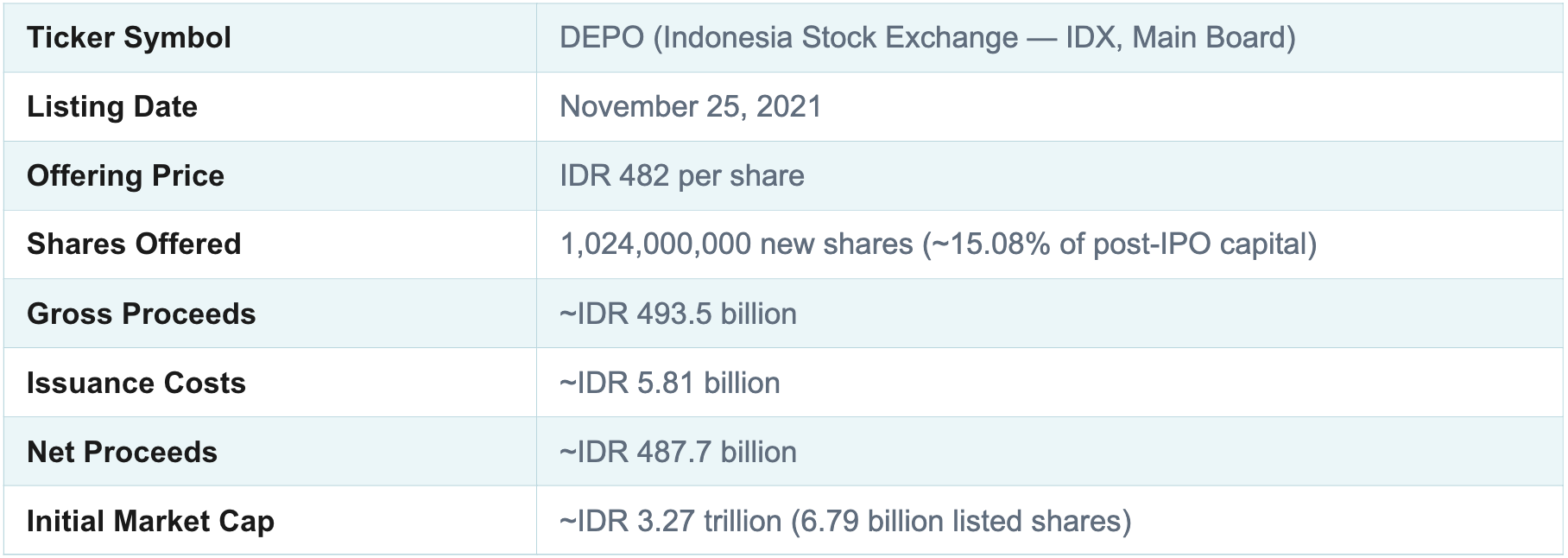
DEPO conducted its IPO and was officially listed on the IDX on November 25, 2021, under the ticker code DEPO on the main board. The company offered 1,024,000,000 new shares (approximately 15.08% of post-IPO capital) at IDR 482 per share, generating gross proceeds of approximately IDR 493.5 billion and an initial market capitalisation of approximately IDR 3.27 trillion.
SECTION II
IPO Objectives & Amount Raised
Overview of the Offering
Strategic Objectives
DEPO’s IPO was clearly designed to support business growth and operational strengthening — not for speculative purposes or mere short-term liquidity. The IPO proceeds were allocated across four key strategic needs: capital expenditures for store expansion, loan repayments to improve the balance sheet, investments in subsidiaries (primarily PT Megadepo Indonesia) for network development, and additional working capital to support smooth operations.
This reflects the company’s sustainability focus on expanding its store network, increasing physical store capacity, and strengthening its balance sheet by reducing debt and increasing equity. Listing on the IDX also forces greater transparency through audited financial statements, regular disclosures, and regulatory oversight — enhancing investor, supplier, and banking partner confidence. DEPO’s management outlined a business strategy around infrastructure strengthening, store expansion, online channel development, and home product innovation, all supported by the IPO.
SECTION III
Use of IPO Proceeds: Was the Money Used Effectively?
Absorption Rate & Disciplined Deployment
Quantitatively, DEPO’s use of IPO proceeds can be considered highly effective. As of end-2024, the company had utilised the vast majority of its IPO proceeds, with remaining unused funds at only approximately IDR 3.416 billion — approximately 0.7% of total net funds. In fact, more recent public disclosures report the remaining balance at only around IDR 0.6 billion. This near-complete absorption rate demonstrates management’s disciplined implementation of the financing plan and prevents IPO funds from sitting idle in the treasury.
Allocation by Category
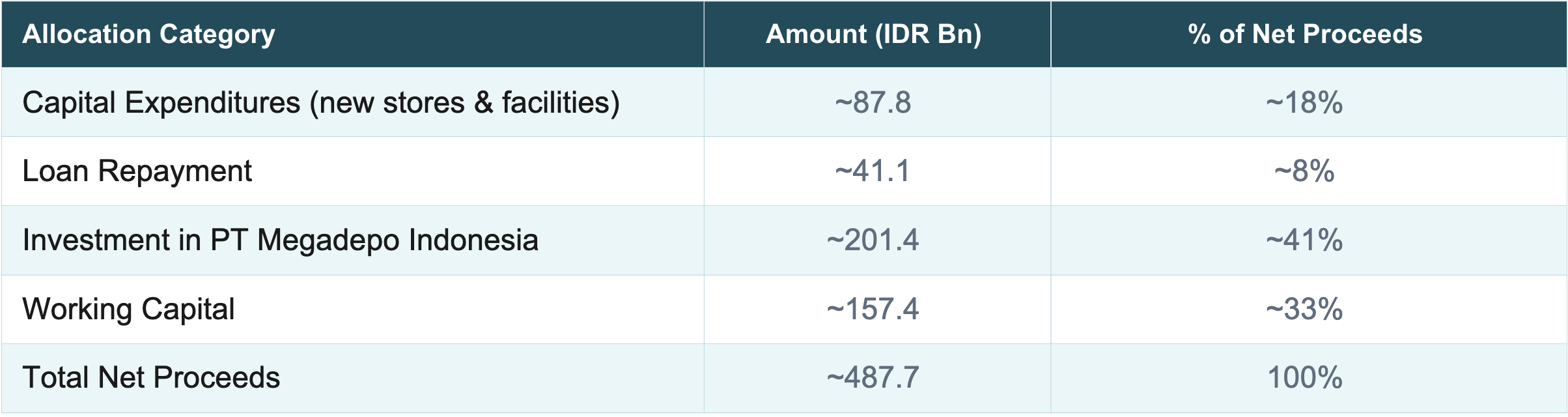
Investments in subsidiaries — primarily PT Megadepo Indonesia — accounted for the largest portion, approximately IDR 201.4 billion (41% of net proceeds). Megadepo used these funds for capital expenditures such as construction of new stores (for example, in Rungkut, Surabaya) and increasing operational capacity, in direct alignment with the building materials retail network expansion strategy.
Approximately IDR 87.8 billion (18%) was used for DEPO’s own capital expenditures — new outlet openings and improvement of store facilities. IDR 41.1 billion (8%) went toward loan repayment, improving the balance sheet structure and lowering interest expenses. The remaining approximately IDR 157 billion (32–33%) was allocated to working capital, supporting smooth operations including building material inventory procurement and strengthening cash flow amidst fluctuating demand in the property and construction sectors.
Impact on Financial Performance
From a financial performance perspective, the use of IPO proceeds supports positive growth, although it does not result in dramatic margin improvements. The 2024 financial report shows DEPO posted revenues of approximately IDR 2.8 trillion and a net profit of IDR 95.2 billion — an increase compared to the prior year. With remaining operating cash of approximately IDR 55.5 billion and total assets of approximately IDR 2.27 trillion, the balance sheet indicates the company is able to balance expansion and debt obligations, reflecting moderate and conservative use of IPO proceeds (Izfs & Supriatna, 2019).
SECTION IV
Post-IPO Financial Performance
Revenue Growth
In 2022, DEPO posted net sales revenue of approximately IDR 2.57 trillion — an increase of approximately 10.4% compared to the pre-IPO year, driven by store network expansion and improving demand in the construction and home improvement sectors. In 2023, revenue grew again to approximately IDR 2.68 trillion (+4.8% YoY), demonstrating continued business expansion despite tighter macroeconomic conditions. In 2024, revenue reached approximately IDR 2.82 trillion (+5.0% YoY). Over the three post-IPO years, DEPO’s revenue increased approximately 10% from 2022 to 2024.
Profitability
Net profit exhibited a fluctuating but overall positive pattern. In 2022, net profit reached approximately IDR 103.4 billion (+18% YoY), with a net profit margin of approximately 4.0%. In 2023, net profit declined to approximately IDR 85.6 billion (net margin ~3.2%), driven by material cost pressures and increased finance costs. In 2024, profits rebounded to approximately IDR 95.2 billion (net margin ~3.4%), maintaining relatively stable profitability at around 3–4% post-IPO. The EBITDA margin of approximately 5.1% in 2024 reflects that DEPO’s core operations remain efficient, although margin pressures have held back net profit growth relative to revenue.
Balance Sheet & Financial Ratios
Total assets at end-2024 were approximately IDR 2.27 trillion, with main components including inventory, accounts receivable, store network, and property/buildings — reflecting the asset-intensive building materials retail model. The debt-to-equity ratio of approximately 0.74 in 2024 indicates a conservative financial structure that utilises leverage moderately. ROA of approximately 4.19% and ROE of approximately 7.27% indicate adequate returns on assets and equity, though not exceptionally high. The company continues to pay cash dividends, reflecting positive operating cash flow generation.
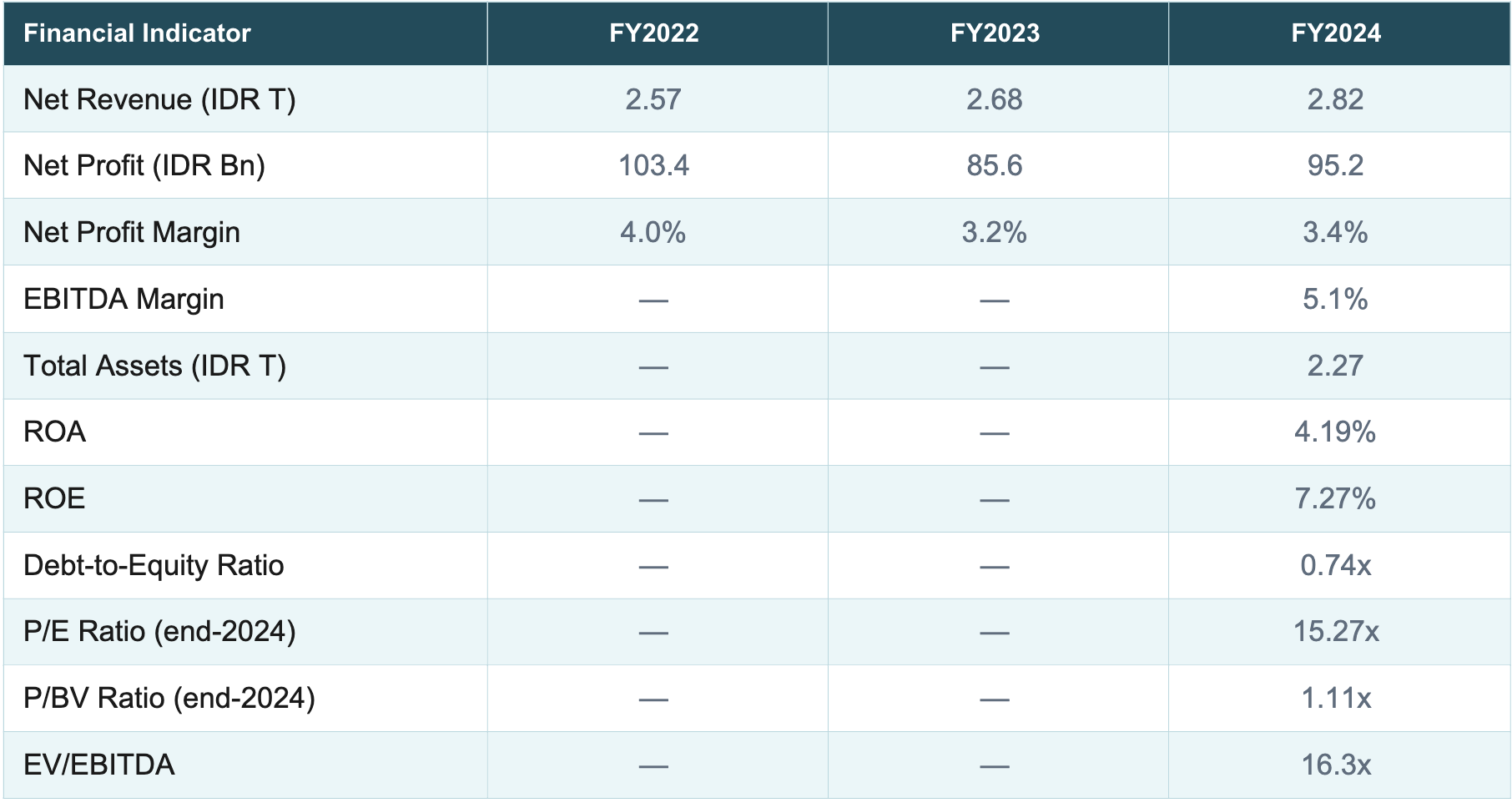
Overall, DEPO’s post-IPO financial performance in 2022–2024 demonstrates that the company has successfully converted its IPO into a viable business growth tool, albeit with limited margin efficiency. Revenue increased gradually from approximately IDR 2.57 trillion in 2022 to IDR 2.82 trillion in 2024, while net profit ranged between IDR 85–103 billion. The asset and liability structure demonstrates prudent use of leverage, keeping the debt ratio moderate, although bank loans remain the primary funding source alongside IPO equity proceeds.
SECTION V
Stock Price Movements
IPO Debut: Explosive First-Day Surge
DEPO’s share price movement after its IPO exhibited a classic pattern of highly enthusiastic debut followed by medium-term correction. DEPO shares were listed on the IDX on November 25, 2021, with an official offering price of IDR 482 per share. Just one day later, on November 26, 2021, DEPO shares reached an initial high of around IDR 746 — an increase of approximately 54.8% from the IPO price — demonstrating intense retail investor euphoria surrounding Indonesia’s first listed building materials retailer (Izfs & Supriatna, 2019).
Six-Month Correction
A surge of approximately 50% in a matter of days reflects typical “overshoot” behaviour in early post-IPO trading, where speculators and early investors hunt for stocks perceived as having high potential. However, from a six-month post-IPO perspective, DEPO’s share price shows a consolidation trend with a slight decline. With DEPO listed on November 25, 2021, the Q2 2022 close serves as the six-month benchmark — with the closing price recorded at approximately IDR 452 per share, below the IPO price of IDR 482.
This means that despite a significant surge in initial days, the share price was unable to sustain the IPO level over the following six months. The secondary market gradually reassessed whether DEPO’s earnings performance, margins, and expansion plans truly justify the high initial price premium — ultimately concluding they did not, at least in the near term (Nima, 2024).

Interpretation
DEPO’s IPO price was likely underpriced (below confident intrinsic value), resulting in the initial surge as an upward price correction. However, once the euphoria subsided, the price re-adjusted to financial fundamentals, which only showed moderate growth. The pattern aligns with research on Indonesian IPO stock prices showing many stocks experience high initial positive returns in the first day or month, but then weaken or consolidate over the following 3–6 months (Daeli & Julaecha, 2026). DEPO’s six-month post-IPO performance can therefore be considered weak relative to its initial debut level, despite healthy underlying business fundamentals.
SECTION VI
Decision Analysis: Would You Invest at the IPO?
The Case For Investing
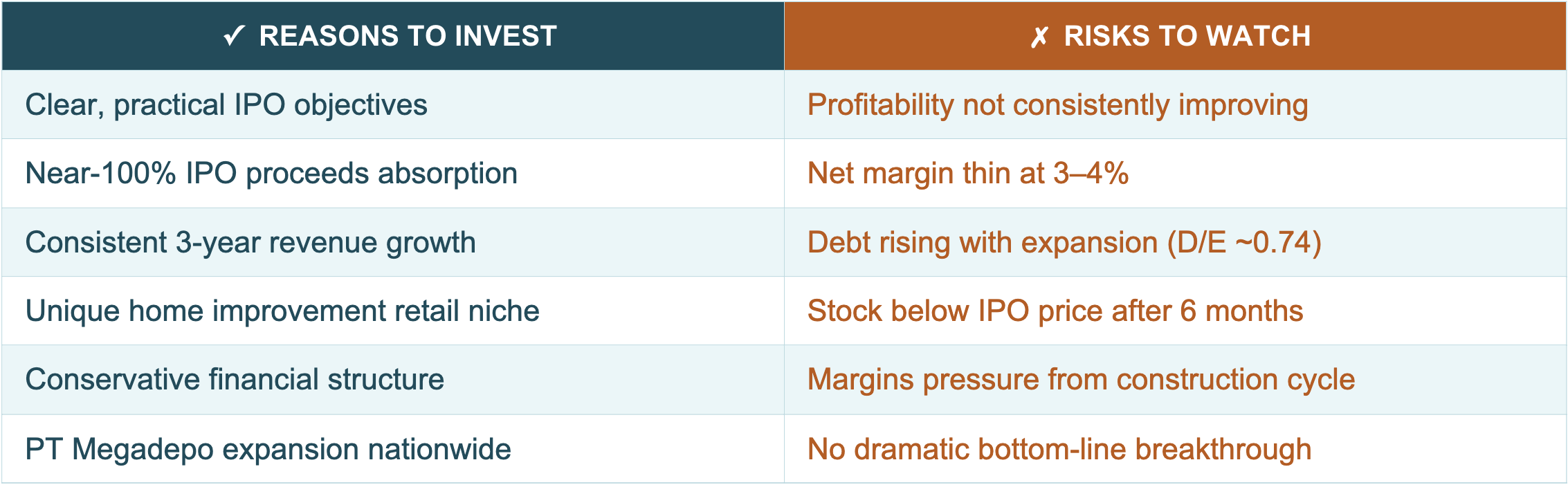
Personally, I would consider investing in DEPO’s IPO, but with a medium- to long-term orientation, rather than as short-term speculation. DEPO’s IPO objective was very clear and practical: raising approximately IDR 487.7 billion for capital expenditures, loan repayments, subsidiary investments, and additional working capital — directly allocated to strategic activities supporting store network expansion and balance sheet strengthening.
The fact that almost all of the IPO proceeds were utilised (only approximately IDR 0.6–3.4 billion remaining by end-2024) demonstrates management’s disciplined use of financing funds — a positive signal for medium-term investors. From a business perspective, DEPO’s IPO supports tangible expansion and consistent sales growth. In the three post-IPO years (2022–2024), revenue increased from approximately IDR 2.57 trillion to IDR 2.82 trillion, with net profit remaining positive throughout. The opening of new stores and increased capacity through capital expenditures and PT Megadepo investments demonstrate that IPO proceeds have contributed meaningfully to physical infrastructure and market reach.
Risks & Cautions
However, investment decisions must remain cautious. First, profitability has not consistently increased — net profit margins hover around 3–4% and even declined from 2022 to 2023 before a partial recovery in 2024. Bottom-line performance has not kept pace with top-line growth. Second, debt and liabilities have increased with expansion: a debt-to-equity ratio of approximately 0.74 and pressure on the current ratio indicates more aggressive reliance on leverage and bank credit, posing risks if macroeconomic conditions or the construction sector weaken.
Third, share price movements suggest that initial enthusiasm may have been overly optimistic. The IPO price of IDR 482 surged to around IDR 746 the following day, but six months later was already below the IPO price (~IDR 452 at Q2 2022 close) — demonstrating that short-term speculative gains were not sustainable.
SECTION VII
Conclusion
The IPO of PT Caturkarda Depo Bangunan Tbk (DEPO) successfully raised approximately IDR 487.7 billion in net proceeds, with a clear and practical objective: supporting capital expenditures, subsidiary investments, increased working capital, and partial loan repayment. The IPO proceeds were used strategically — with the vast majority disbursed as planned, leaving only approximately IDR 0.6–3.4 billion remaining by end-2024 — demonstrating a high absorption rate and disciplined implementation of the business plan. This confirms that DEPO’s IPO is not simply a stock exchange listing transaction, but a crucial financing instrument for strengthening building materials retail infrastructure and accelerating store network expansion.
Post-IPO financial performance from 2022 to 2024 shows an overall positive trend, particularly in consistent sales growth: revenue increased from approximately IDR 2.57 trillion in 2022 to IDR 2.82 trillion in 2024, with net profit remaining positive throughout, albeit fluctuating between IDR 85–103 billion annually. This performance was accompanied by increasing liabilities and pressure on leverage ratios, indicating that the company’s growth was driven partly by increasing debt, not solely by equity support from the IPO. This combination reflects DEPO’s resilience and growth, but the company has not yet achieved exceptional performance (Mutasowifin, Ramadhan, & Viana, 2024).
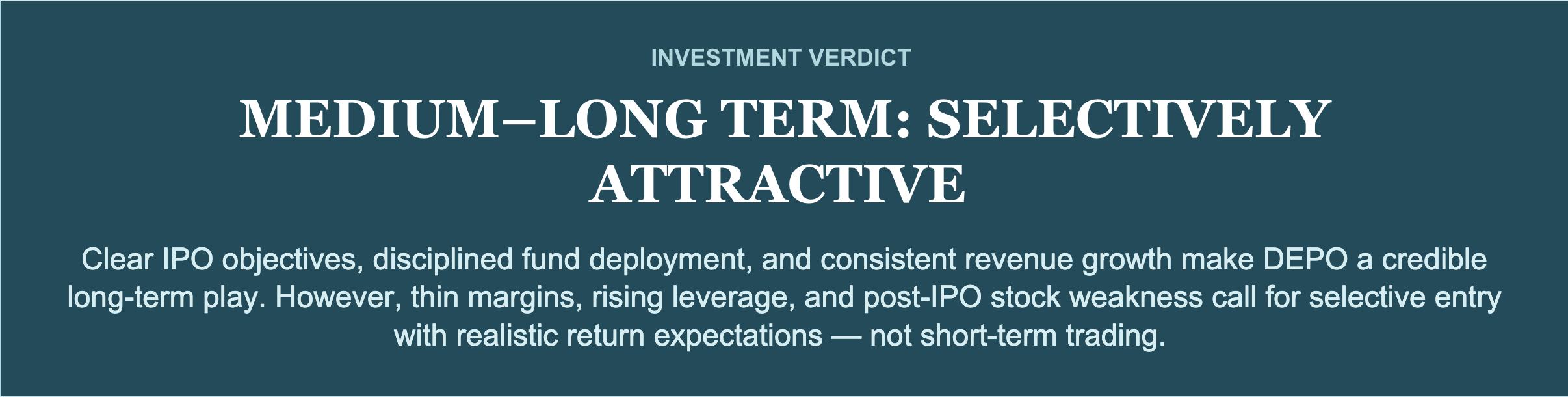
From a market perspective, DEPO shares had a very strong debut — soaring from IDR 482 to approximately IDR 746 the following day (+54.8%) — reflecting intense initial investor enthusiasm. However, six months later, the share price was already below the IPO price (~IDR 452 at Q2 2022 close), indicating that short-term optimism was not fully sustainable. The stock’s strong initial performance but weakening in the medium term suggests the market is reassessing whether fundamentals and profitability justify the initial price premium. For medium- to long-term investors with realistic expectations, DEPO presents a disciplined, infrastructure-backed investment case with selective attractiveness.
REFERENCES — DAFTAR PUSTAKA
Sources & Bibliography
- Nima, R. V. R. (2024). Studi Harga Saham Pasca IPO di BursaEfekIndonesia. Jurnal Akuntansi, Keuangan, Dan Manajemen, 5(2), 149–160. https://doi.org/10.35912/jakman.v5i2.3021
- Kurnia, A.,Widaryanti, W., & Latifah, N. (2022). Faktor–Faktor YangMempengaruhi Initial Return. Jurnal Ilmiah Fokus Ekonomi, Manajemen, Bisnis & Akuntansi (EMBA), 1(1), 96–104.
- PTCaturkardaDepo Bangunan Tbk. (2023). Laporan Keuangan Konsolidasian 30 Juni 2023 dan 31 Desember 2022. corporate.depobangunan.co.id
- Izfs, R. D., &Supriatna, N. (2019). Pengaruh Initial Public Offering (IPO) Terhadap Kinerja Perusahaan. Jurnal Riset Akuntansi dan Keuangan, 7(1), 19–28.
- Mutasowifin, A., Ramadhan, M. F., & Viana, E. D. (2024). Analysis of the Impact of Initial Public Offering on Financial Performance. JMBI UNSRAT, 11(1), 594–608. https://doi.org/10.35794/jmbi.v11i1.54431
- Purnama, D. S., & LiniIngriyani, S. T. (2025).Apakah Dana IPO Efektif Dalam Meningkatkan Kinerja Keuangan? Seminar Nasional Akuntansi dan Manajemen PNJ, Vol. 6, No. 1.
- Fadhilah, A. N., Safari, N., & Utami, H. T. (2024).DinamikaE-IPO di Pasar Modal Indonesia. Journal of Management, Economics, and Entrepreneur, 3(1), 102–113.
- Daeli, K. K., &Julaecha, H. E. (2026). Faktor Terjadinya Underpricing Saham Ketika Perusahaan IPO di Bursa Efek Indonesia. Jurnal Kecerdasan Buatan dan Bisnis Digital (RIGGS), 4(4). https://doi.org/10.31004/riggs.v4i4.5164
YOUR NEXT STEP
Join MM Pro
Binus Business School
Be Part of a Global Academic Community
Sharpen your business acumen, expand your global network, and lead with confidence in the world’s most dynamic markets.


Comments :