



IPO ANALYSIS OF PT FORE KOPI INDONESIA TBK

ROIHANS MUHAMMAD IQBAL
2702751832 · Binus Business School
PT FORE KOPI INDONESIA TBK
IPO Analysis · April 2025

SECTION 01
Introduction
The Indonesian capital market has recently seen an increase in companies going public, particularly those focused on consumer growth. Many of these companies conduct IPOs not to stabilize their finances but to accelerate expansion — PT Fore Kopi Indonesia Tbk (FORE) being a prime example.
FORE launched its IPO in April 2025, positioning itself as a high-growth player in the competitive food and beverage (F&B) sector. Listing at such an early stage of expansion raises a key question: does the IPO reflect a sound business decision or is it driven more by market expectations for future growth?
This paper analyses FORE’s IPO by examining its corporate action and objectives, use of proceeds, financial performance, share price movements, and investment attractiveness.
SECTION 02
IPO Objectives & Proceeds
FORE issued approximately 1.88 billion shares at a price of IDR 188 per share, raising approximately IDR 353 billion. The IPO opened approximately 21% public ownership, while majority ownership remained with Fore Holdings Pte. Ltd., indicating a concentrated ownership structure.
The primary purpose of this action was to fund expansion — opening new stores, supporting subsidiary growth, and strengthening working capital — signalling a growth-first strategy rather than financial restructuring.
Strategically, this aligns with coffee retail dynamics where scale is crucial for brand visibility. However, such an approach carries higher execution risk, as success depends on translating expansion into sustainable profitability.

SECTION 03
Use of IPO Proceeds
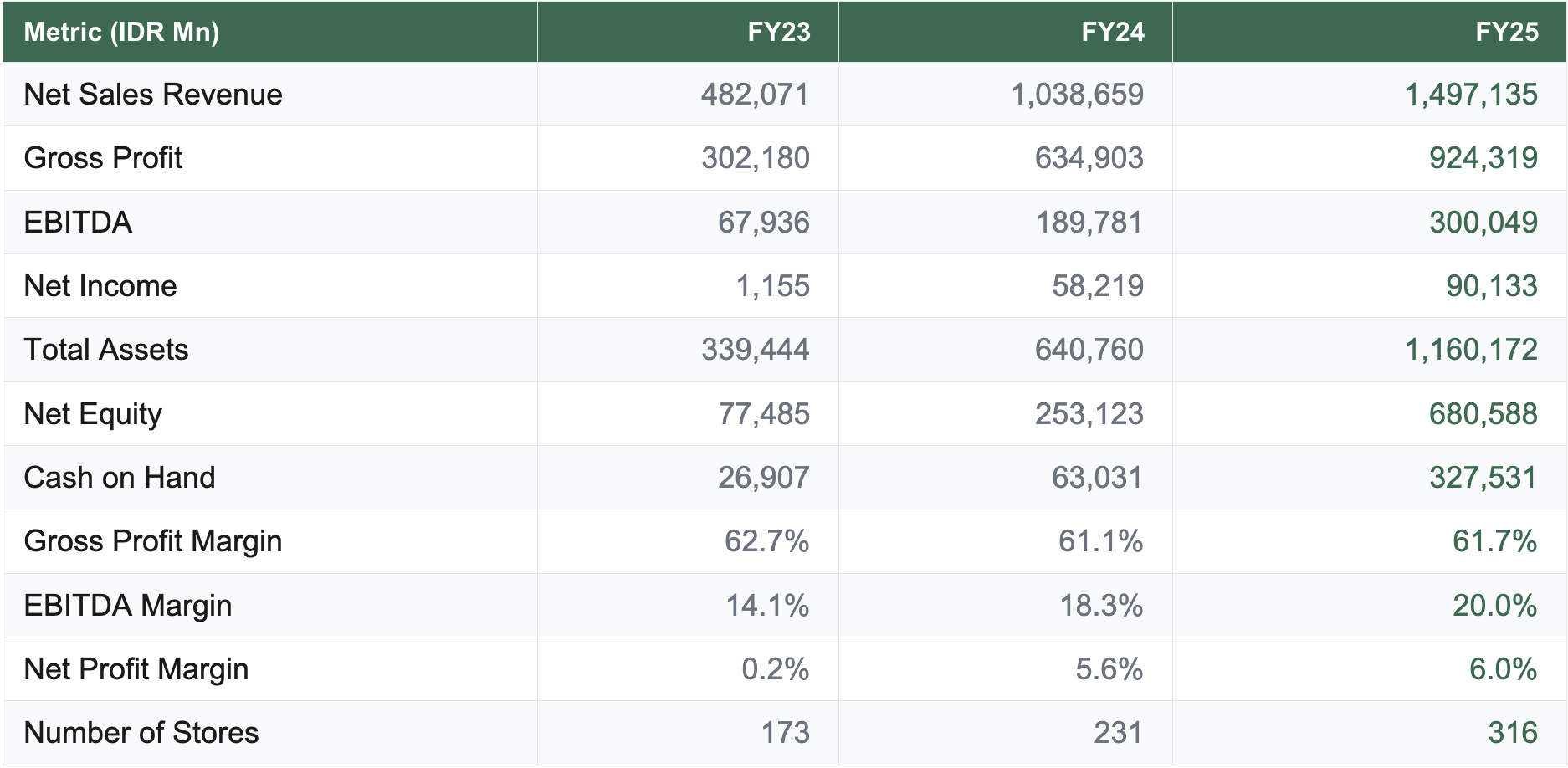
The allocation of FORE’s IPO proceeds was used for strategic expansion, consistent with F&B industry dynamics. FORE increased its store count from 231 in 2024 to 316 in 2025, demonstrating that the funds were being actively utilized.
While business expansion supported revenue growth and brand strengthening, the food and beverage industry is highly competitive. Rapid scale-up often leads to increased operating costs and inefficiencies — reflected in FORE’s high operating costs despite strong revenue growth.
Furthermore, the company relies heavily on leased assets, creating fixed cost obligations that increase financial risk if growth slows. Overall, the strategic use of IPO proceeds is sound but execution-dependent.
SECTION 04
Post-IPO Financial Performance
FORE demonstrated strong financial growth following its IPO. Revenue increased from approximately IDR 1.04 trillion in FY24 to IDR 1.50 trillion in FY25 — representing growth of approximately 44%. Net profit also improved from IDR 58.2 billion to IDR 90.1 billion.
SECTION 05
Stock Price Movement
FORE’s stock performance since its IPO has been exceptional. On its first trading day, the stock closed at IDR 252 — a 34% premium over its IPO price of IDR 188. Over the following year, the stock reached approximately IDR 975, implying a return of over 400%.
The price movement unfolded in three phases: (1) an initial surge driven by strong market demand and investor enthusiasm; (2) a period of volatility as the market reassessed valuation; and (3) a renewed upward trend indicating increased confidence in the company’s growth prospects.


SECTION 06
Investment Decision
Investing in FORE at the IPO stage can be categorized as a high-risk, potentially high-reward decision. FORE presents a strong growth narrative supported by increasing revenue, improving profitability, and an aggressive expansion strategy.
Research by Ritter (1991) shows that IPOs often generate high initial returns due to underpricing and strong investor demand. FORE’s 34% first-day gain is consistent with this pattern, indicating that initial price movements may not be driven solely by fundamentals.
Analytically, FORE sits between two precedents: Starbucks — which successfully translated rapid store expansion into long-term profitability — and WeWork, whose growth narrative collapsed under unsustainable fundamentals. FORE has demonstrated increasing profitability but has not yet proven strong operational efficiency at scale.
Therefore, investing in FORE is considered speculative: it depends heavily on the company’s ability to translate expansion into sustainable, efficient growth. Suitable for investors with higher risk tolerance and a long-term horizon; less suitable for those seeking stable, predictable returns.
SECTION 07
Conclusion
FORE’s IPO demonstrates a clear growth-oriented strategy, with proceeds effectively allocated to business expansion. The company has demonstrated strong initial financial performance and has attracted positive market sentiment, as reflected in dramatic share price appreciation.
However, the company’s future success depends on its ability to manage rapid expansion while maintaining profitability. The high valuation and strong share performance indicate that investor expectations are already elevated.
Overall, FORE can be seen as a promising investment with material risk caveats. Long-term value creation will depend on execution rather than strategy alone.

Sources & Bibliography
- Fore Annual Report (audited) for 2024–2025.
- FORE Stock Movement data sourced from Yahoo Finance.
- Ritter, J. R. (1991). The long-run performance ofinitialpublic offerings. The Journal of Finance, 46(1), 3–27.
- Gelles, D., & de la Merced, M. J. (2019, September 30). WeWork withdraws I.P.O. filing. The New York Times.
- Shedd, K. (2019, January 7). How Starbucks went from one coffee bean store to an$80 billionbusiness. CNBC.
YOUR NEXT STEP
Join MM Pro
Binus Business School
Become part of a Global Academic Community — sharpen your business acumen, expand your network,
and lead with confidence in the world’s most dynamic markets.

Comments :