



IPO Analysis of Bukalapak (BUKA)
 DAVID GAUTAMA
2602626392 · Binus Business School
Corporate Finance · IPO Analysis
BUKALAPAK (BUKA)
Nearly 5 Years After IPO
Hype, Correction, and the Pursuit of Sustainable Growth
IPO Date: August 6, 2021 · Ticker: BUKA · IDX


SECTION I
Overview of Indonesia’s Digital Economy and Bukalapak
Indonesia’s Digital Landscape
Over the past decade, Indonesia has experienced rapid growth in its digital economy, driven by higher internet penetration rates, expansive smartphone adoption, and a tech-friendly middle class. Internet penetration reached 80.66% in 2025 — approximately 229.4 million people out of a total population of 284.4 million — up from 79.50% in 2024. The number of active smartphone users has jumped from 54 million in 2015 to 209.3 million in 2023. The middle class and aspiring middle class now make up approximately 66.35% of the total population.
With this environment, it is not surprising that e-commerce platforms have become a major driver of economic activity, especially in helping small and medium enterprises (SMEs) grow beyond traditional offline markets. This fertile ground made Indonesia one of the most attractive destinations for technology IPOs in Southeast Asia.
Bukalapak: From Marketplace to Digital Ecosystem
Bukalapak was founded in 2010 by Achmad Zaky, Nugroho Herucahyono, and Muhamad Fajrin Rasyid. Initially functioning as an online marketplace, facilitating individual sellers to connect with potential purchasers, the company grew into a broader digital ecosystem encompassing digital products, gaming services, fintech, and Mitra Bukalapak — a platform aimed at digitalising traditional warungs and including them in the digital economy.
In January 2020, Rachmat Kaimuddin became the new CEO, replacing Achmad Zaky who resigned alongside the other co-founders. This leadership transition was accompanied by significant strategic changes, including the eventual decision to pursue an IPO. Based on a Nielsen study in 2022, Bukalapak leads digital penetration among warungs in Indonesia at 56%, underscoring its unique positioning in the offline-to-online space.
On August 6, 2021, Bukalapak conducted its IPO on the Indonesia Stock Exchange (IDX) under the ticker code BUKA — becoming the first unicorn company to list on the IDX, and recording the largest IPO in the history of the Indonesian stock exchange, raising IDR 21.9 trillion. In a wider context, it mirrored strong government support for high-growth tech startups to list via the IDX Acceleration Board, and reflected surging investor interest in Indonesia’s technology sector.

SECTION II
IPO Objectives and Proceeds
IPO Objectives
It was not in one day that Bukalapak decided to go public; the decision was deliberated as part of a larger, long-term vision. Gaining substantial capital was one of the primary reasons — operating in an extremely fast-changing technology industry, possessing significant capital is a key lever for scaling, platform improvement, and sustained innovation.
Bukalapak also aimed to strengthen its ecosystem, evolving from a marketplace into an all-in-one digital platform. This included Mitra Bukalapak — helping traditional retail businesses digitise and reach a wider customer base without needing to be online themselves. Technology investment — in infrastructure, data analytics, and AI — was also a core objective, aiming to make the application more user-friendly and logistics more seamless.
Competitive positioning was another critical driver. In the crowded Indonesian e-commerce space dominated by well-capitalised players like Shopee and Tokopedia, IPO funds could enable Bukalapak to defend and expand its market share. The listing also enabled early investors to partially exit, which is common in tech IPOs — creating a win-win for founders, early backers, and the company through increased credibility and public exposure.
IPO Proceeds

The IPO process was conducted swiftly: bookbuilding from July 9–19, public offering July 28–30, and stock market listing on August 6, 2021. The total funds raised made Bukalapak one of the largest publicly listed tech companies in Southeast Asia at that time. The 4× oversubscription reflected overwhelming investor enthusiasm for Indonesia’s tech sector, fuelled by post-pandemic digital adoption tailwinds.
The intended use of funds, as stated in the IPO prospectus, was primarily directed toward working capital and capacity expansion, alongside strategic investments such as acquisitions and partnerships to bolster the ecosystem. This illustrates that the company was more inclined toward expanding reach rather than chasing short-term profits — a hallmark of growth-first tech companies.

SECTION III
Use of IPO Proceeds
Strategic Deployment
After going public, the funds have been utilised in various areas to bolster Bukalapak’s long-term plans. Among the largest pieces was extending the Mitra Bukalapak platform — digitising small retail shops to sell mobile credits, electricity tokens, and offer financial services. This move strategically differentiates Bukalapak from competitors who mostly chase urban users, as Mitra Bukalapak further penetrated tier-2 and tier-3 cities where traditional warungs dominate and rivals have scarce presence.
Bukalapak also highlighted digital-only products in gaming and other sectors. This segment tends to provide better margins than traditional e-commerce transactions, serving as a strategic revenue engine. The company also pursued both investments and acquisitions for inorganic growth — key moves include acquiring iPrice in 2023, backing logistics aggregator Crewdible through its subsidiaries, and supporting gaming startups via Game Multi Realms — all aimed at synergising services and growing market share.
Significant investment was also made in technology infrastructure: cloud computing, data analytics, and platform optimisation — essential for enabling the platform to scale, run cost-efficiently, and deliver sufficient user experience. As of 2025–2026, approximately 25% of the remaining IPO funds have been invested in safer financial instruments such as time deposits and government bonds, providing Bukalapak with breathing room and liquidity for potential acquisitions or future growth opportunities.
Evaluation of Effectiveness
Bukalapak can be analysed from two perspectives: strategic and financial. Strategically, the company has evolved well beyond a marketplace — Mitra Bukalapak and digital-driven products clearly demonstrate diversification of reach and revenue. However, from a financial perspective, the outcome remains mixed. Net income continues to struggle due to high costs, particularly in marketing and technology. New business segments are not scaling as fast as hoped.
The long-term ecosystem strategy offers genuine promise, but requires long gestation periods and heavy upfront investment before yielding real returns. Overall, the strategy can be perceived as valid, but is difficult to execute from a financial perspective. The groundwork exists, however the success of converting that into profitable results remains an open question.
SECTION IV
Post-IPO Financial Performance
Revenue Trends
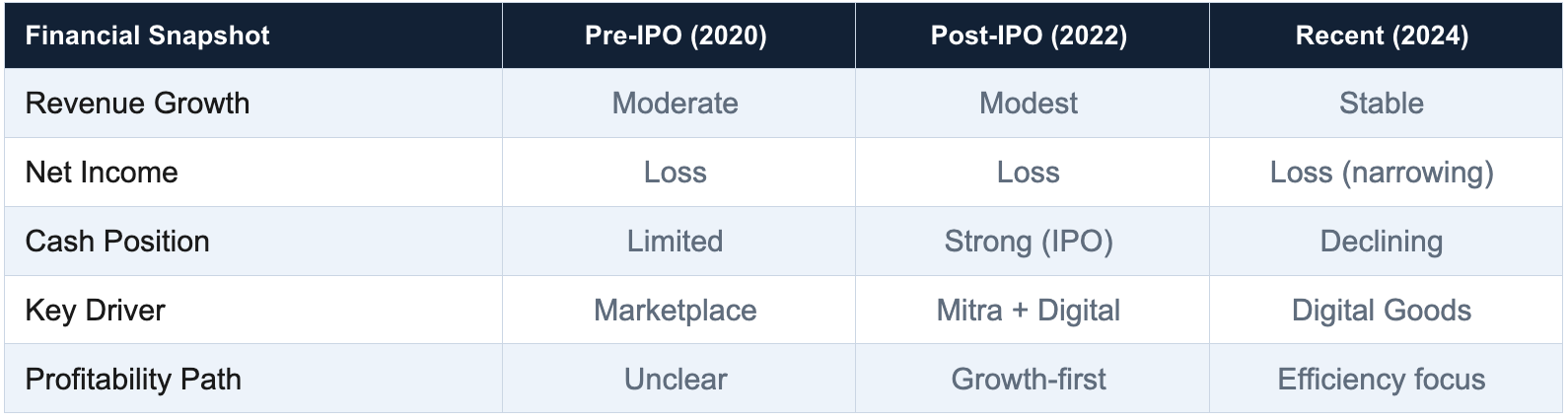
Since its IPO, Bukalapak’s revenue growth has remained relatively modest. It is primarily driven by digital goods and the Mitra segment — these domains are quite sticky and scalable. On the other hand, the marketplace side is not scaling quickly due to the intensely competitive Indonesian e-commerce landscape. Shopee and Tokopedia continue to drive aggressive promotions and subsidies, pressurising Bukalapak in a price war it cannot sustain indefinitely.
Profitability
Even as a public company, Bukalapak continues to post losses, mainly due to excessive expenditure. IPO-gathered capital was spent on customer acquisition, marketing campaigns, and technology investments — adding up to a significant expense base. The company has attempted efficiency improvements by reducing promotional expenditure and optimising operations, however profitability has not yet been achieved. This is a common pattern in the technology industry, where companies balance growth and profitability in a perpetual tension.
Financial Position
Bukalapak’s balance sheet is one of its relative strengths. Due to the large IPO raise, the company still holds a cash cushion enabling continued investment in growth without excessive dilution. However, the downside is that the company is expending resources aggressively across multiple fronts. If losses continue for too long, that cash buffer will erode — resulting in the urgent need to address efficiency and identify a more sustainable path to profitability.
SECTION V
Stock Price Movements
Initial Market Reaction
BUKA stock made a massive move on listing day, touching the upper circuit limit — illustrating the extraordinary desirability and favourability among the investing public. This hype was fuelled by a broader tech stock bubble, strong Bukalapak branding, and Indonesia’s first unicorn listing narrative. The stock opened at a significant premium to its IPO price of IDR 850.
Short-Term Performance and Long-Term Decline
However, early excitement was short-lived. Within six months, investor rationality returned as the stock fell sharply below its IPO price. Several factors drove this: financial performance was well below expectations (particularly on profitability), global tech stocks suffered during the 2022–2023 tech winter, and investors grew increasingly concerned about valuation and competition intensity.
Over the longer haul, the stock has declined dramatically — losing approximately 85% of its value over five years, from IDR 850 at IPO to around IDR 159 by April 2026. This indicates that the original IPO valuation was significantly overoptimistic. Investors have since re-rated the company based on fundamentals rather than narrative.

Interpretation
This pattern is quite normal for high-hype tech IPOs — compare GoTo Group (GOTO): a massive initial surge followed by a prolonged correction once fundamentals came into focus. For Bukalapak, the stock’s long-term trajectory reflects the broader challenge of monetising a digital ecosystem in a fiercely competitive market without clear near-term profitability. The market and technology community in Indonesia now judge performance with far greater scrutiny than at the time of listing.
SECTION VI
Investment Decision Analysis
Investment Considerations
There are clear pros and cons to consider for investors who considered entering during the IPO. The upside: Bukalapak operates in a high-growth industry, has solid long-term digital ecosystem prospects, and its focus on SMEs and offline-to-online integration through Mitra Bukalapak is genuinely unique and underserved by competitors. The barriers to entry in Tier-2 and Tier-3 city penetration are significant.
However, the risks are equally clear: continued unprofitability, an extremely competitive landscape dominated by better-capitalised rivals, and a monetisation strategy that remains an open issue for Bukalapak and Indonesian tech companies broadly. The lack of a clear timeline to profitability makes long-term holding speculative.
Investment Decision
As an investor, Bukalapak at IPO was more suitable for short-term trading than long-term holding. Quick returns were achievable on the IPO hype, but the severe price decline that followed demonstrates the danger of entering high-growth, high-loss entities with long-term conviction before fundamentals are established.
A more conservative approach — waiting for the company to demonstrate a clearer path to profitability and steadier growth — would have been more prudent. The experience of BUKA serves as a useful case study in the divergence between narrative-driven IPO pricing and fundamental-driven long-term valuation in emerging market tech sectors.

SECTION VII
Conclusion
Bukalapak’s IPO was a major milestone for Indonesia’s capital market — demonstrating deep investor interest in the country’s digital economy and setting a record for the largest fundraise in IDX history. The company raised IDR 21.9 trillion, converted it into an expanding digital ecosystem, and positioned itself as the go-to platform for Indonesia’s offline SME economy through Mitra Bukalapak.
However, significant challenges have persisted: despite service growth, profitability remains elusive. The severely declining stock price — losing 85% of its value over five years — has materially hurt investor confidence and serves as a cautionary tale about the dangers of narrative-driven IPO valuations in high-growth, high-loss tech companies.
In summary, Bukalapak delivered an IPO that was ambitious strategically but financially difficult. Long-run success will come down to how consistently and precisely the company executes its strategy. It is not just about growth for growth’s sake — it is about refining operations, squeezing out efficiencies, and making smarter use of resources over time. The groundwork exists; the execution is what remains to be proven.

REFERENCES
Sources & Bibliography
- ANTARA News. (2025). APJIIcatattingkat penetrasi internet Indonesia capai 80.66 persen. antaranews.com
- Bisnis.com. (2023).Bukalapakakuisisi iPrice, ternyata ini tujuannya. teknologi.bisnis.com
- Blank, S., & Dorf, B. (2020). The Startup Owner’s Manual. John Wiley & Sons.
- Damodaran, A. (2012). Investment Valuation: Tools and Techniques for Determining the Value of Any Asset. John Wiley & Sons.
- Goodstats. (2024). 209.3juta orang di Indonesia menggunakan smartphone pada tahun 2023. data.goodstats.id
- Huda, N., Ayu, D., &Septyarini, R. (2024). Digital Economy Outlook 2025. Centerof Economic and Law Studies (CELIOS).
- IDN Financials. (2021).Bukalapakscores IDR 21.9 trillion in IPO, the highest return of all time. idnfinancials.com
- Kaur, D. (2022). Here’s howBukalapakis transforming Indonesia — one “warung” at a time. Tech Wire Asia.
- Kompas. (2021). Unicornpertamadi bursa efek Indonesia. kompas.id
- Liputan6.com.(2023). Gandeng Bukalapak,Crewdible membantu UMKM jadi naik kelas. liputan6.com
- Pagano, M., Panetta, F., & Zingales, L. (1998). Why do companies go public? The Journal of Finance, 53(1), 27–64.
- Parker, G. G., Van Alstyne, M. W., & Choudary, S. P. (2016). Platform Revolution. WW Norton & Company.
- PT Bukalapak.comTbk. (2021).Prospektus Penawaran Umum Perdana Saham. IDX.
- Putri, R. C., & Fahad, A. M. (2025). Analisis StrategiDiferensiasidalam Peningkatan Loyalitas Pelanggan. YUME: Journal of Management, 8(1), 578–590.
- Rajah & Tann Asia. (2021). PT Bukalapak.comTbk:Bukalapak’s Initial Public Offering. rajahtannasia.com
- Ries, E. (2011). The Lean Startup. Crown Business.
- Ritter, J. R., & Welch, I. (2002). A review of IPO activity, pricing, and allocations. The Journal of Finance, 57(4), 1795–1828.
- SWA.co.id. (2025).Bukalapakkenalkan multi-realm games di IGDX 2025. swa.co.id
- Universitas Gadjah Mada. (2026).Jumlahkelas menengah RI turun, minimnya ketersediaan lapangan pekerjaan. ugm.ac.id
YOUR NEXT STEP
Join MM Pro
Binus Business School
Be Part of a Global Academic Community
Sharpen your business acumen, expand your global network, and lead with confidence in the world’s most dynamic markets.


Comments :