

BINUS University Team Secures Third Place in Deloitte x PT. KAI x Bluscape Built Environment Case Competition 2025 with Innovative Railway Reactivation Strategies
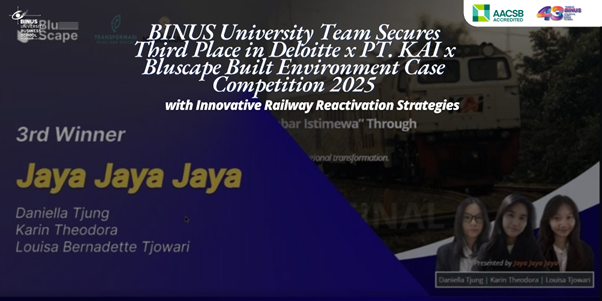
An a testament to their strategic insight and collaborative prowess, the team from BINUS University—Daniella Tjung, Karin Theodora, and Louisa Tjowari, presenting as “Jaya Jaya Jaya”—claimed third place in the Deloitte x PT. KAI x Bluscape Built Environment Case Competition 2025. Guided by coach Najah Najmia Halim, the team delivered a compelling presentation titled “The 3 Core Strategies for Building ‘Jabar Istimewa’ Through Sustainable Railway Reactivation.” Their approach integrated infrastructure, financing, and technology to drive long-term regional transformation in West Java, impressing judges with its alignment to national goals like Net Zero 2060 and inclusive economic growth.
The competition unfolded across multiple stages, each enriched by expert insights. In the preliminary and semi-final rounds, focused on Deloitte’s case for Hang Nadim International Airport in Batam, the team proposed “Triple Impact Solutions” emphasizing sustainability, economy, and society. Key contributors included Dewandha Finartra (Airside & Cargo Operations Management, Hang Nadim Airport), who highlighted real-world cargo challenges; Daniel Christian Butarbutar (Airlines Cargo & Logistics Analyst, Hang Nadim Airport), providing market dynamics analysis; and Muhammad Fadhli Haqqi Wibisono (Product Design Engineering student, BINUS ASO), offering technical inputs on sustainable design.
Advancing to the final round on PT KAI’s case, the team presented their railway reactivation framework. This stage benefited from guidance by Didiek Hartantyo (Former President Director of PT KAI), who connected them with experts to align with PT KAI’s vision; M. Arief Tri Wibowo (President Director’s Working Team & Secretariat, PT KAI), who refined their long-term impact strategies; Adriansyah Yasin Sulaeman (Wayfinding Design Advisor, PT KAI), emphasizing user-centered intermodal connectivity; Ezra Peranginangin (FM Structural, BINUS ASO School of Engineering), advising on systems integration; and Rafi Lamikan (Mechanical Engineering student, ITS), adding depth to regenerative braking concepts.
The Case: Revitalizing West Java’s Dormant Railways
The competition centered on PT Kereta Api Indonesia (PT KAI), Indonesia’s state-owned rail operator, tasked with reactivating 11 dormant railway lines in West Java as part of a Rp15–20 trillion investment. PT KAI’s mission focuses on enhancing regional connectivity, logistics efficiency, and economic-tourism growth, with 57.228 million passengers in Q2 2025. The reactivation aligns with national priorities like PSN (National Strategic Projects) and Net Zero 2060, aiming to stimulate local economies, reduce congestion, and promote sustainable mobility.
External analysis via PESTLE revealed opportunities in political infrastructure funding (IDR 400.3T in 2025), economic GDP growth (4.7%), social urbanization, technological digitalization (>78% internet penetration), environmental waste reduction targets (30% by 2029), and legal packaging regulations. A primary survey (N=33) showed strong demand for better connectivity (72%) and economic inclusion (70%). Stakeholder personas—KAI, citizens, government, and MSMEs—highlighted pain points like operational sustainability, fair land acquisition, budget constraints, and logistics costs.
Root cause analysis identified key issues: strategic misalignment (e.g., unclear prioritization), financial viability (e.g., limited blended financing), and infrastructure readiness (e.g., poor multimodal integration, delayed electrification). The central question: “How can the West Java railway reactivation program be transformed within five years (2026–2031) into a financially sustainable, technologically modern, and community-inclusive rail network that strengthens connectivity and regional economic growth?”
The 3 Core Strategies: A Roadmap to “Jabar Istimewa”
The team’s solution resets priorities across three phases—Pilot (low-capital lines like Rancaekek–Tanjungsari), Development (strategic anchors like Banjar–Cijulang), and Stability (high-complexity TOD like Bandung–Ciwidey)—to manage risks and ensure self-sustaining operations. Land acquisition, a major hurdle, is addressed through ownership-based relocation in premium TOD areas and infrastructure-empowerment partnerships in regional zones, emphasizing legal readiness as a gateway.
- Strategic & Organizational Alignment: This strategy focuses on phased prioritization to minimize capital risks and integrate heritage assets via PPP/TOD frameworks. It includes asset-based compensation, establishing a Non-Farebox Unit, and community partnerships to resolve disputes and foster inclusivity.
- Financial Viability & Economic Value Creation: Shifting from APBN/APBD dependency, the team proposes an ESG-based financing ecosystem: green bonds for low-carbon infrastructure, social bonds for job creation, and PPP/KPBU for governance. Corridor-specific opportunities—e.g., coastal tourism in Pangandaran, agro-tourism in Ciwidey—create dynamic economic belts, boosting MSME participation by 70% and tourism spending by Rp 3 million per visitor.
- Technological & Infrastructure Readiness: Advancing to full electrification (80% emission reduction), regenerative braking (8–9% energy savings), and smart crossings (70% accident reduction). Intermodal hubs and the enhanced KAI App enable seamless multimodal planning, reducing travel time by 40% and emissions by 15%, while promoting public transport adoption (40%+ new users).
Feasibility, Implementation, and Projected Impact
A five-year timeline (2026–2031) outlines planning, execution, and maintenance, with risks mitigated through legal consultations, pilot testing, and eco-standards. KPIs include 8.67% energy efficiency, 1,937 tons CO₂e reduction, 1% regional GDP boost, and 15% customer satisfaction increase. Financial metrics project a 2.23-year payback, Rp3.31 trillion NPV, 67.2% IRR, and 145.36% ROI.
Expert validations from PT KAI leaders affirmed the strategies’ alignment with seamless mobility, zero accidents, and sustainable growth. In conclusion, the team echoed PT KAI’s commitment to energy-efficient, rail-based economic integration, empowering communities toward Net Zero 2060. This victory highlights BINUS University’s excellence in addressing real-world infrastructure challenges.
Members:
– Daniella Tjung – Master Track Management
– Louisa Bernadette Tjowari – Finance
– Karin Theodora – Finance
Coach:
Najah Najmia Halim
Comments :