


BINUS University Team EDG Consulting Claims Third Place in 180DC IPB Global Business Case Competition 2025 with Innovative MaxSEAmize Strategy for SeaBank
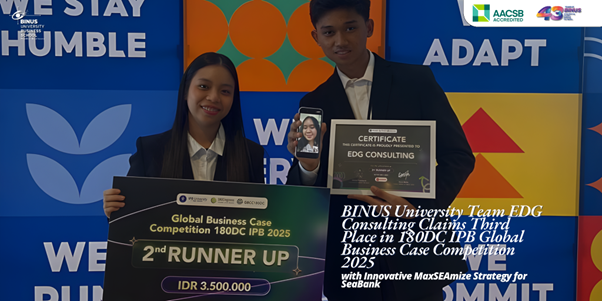
In an impressive showcase of strategic thinking and financial acumen, EDG Consulting from BINUS University earned third place in the 180DC IPB Global Business Case Competition 2025. Their proposal leverages SeaBank’s strong liquidity and capital position to expand productive lending, particularly through supply chain financing for MSMEs, amid a national liquidity shift creating opportunities for digital banks. The strategy emphasizes ecosystem integration, product diversification, and innovative tools like the SeaBiz app to drive growth, profitability, and market penetration.
The Case: Capitalizing on Liquidity for Lending Expansion
The competition focused on SeaBank, a leading digital bank in Indonesia, navigating a dynamic financial landscape. As outlined in the deck’s problem analysis, SeaBank has demonstrated robust 3-year growth: total loans increased from Rp15.9 trillion in 2022 to Rp22.4 trillion in 2024 (a 540% acceleration in digital lending), CAR remained strong at 30.8%, LCR hit 449.95% (nearly 4.5 times the minimum), NPL gross at 1.74% indicating a healthy portfolio, and ROA rising to 1.55% with consistent profit growth. Competitor analysis positioned SeaBank as a “leader” in product value proposition and ecosystem integration, ahead of challengers like Jago, Jenius, NeoBank, and blu, but highlighted the need to diversify into new segments to maintain dominance.
External factors underscore a “liquidity shift creating a lending window.” National momentum includes a Rp200 trillion government liquidity injection, OJK’s 2025 credit growth projection of 10-12% YoY, BI Rate at 6.25% with relaxed GWM, and intensified funding competition as major banks (Himbara) lower deposit rates. Industry impacts show the national LDR falling to 78%, excess liquidity pushing down cost of funds and yields, with focus shifting from deposits to channeling loans. Key takeaway: Loose liquidity and low rates open opportunities for SeaBank to boost lending, growth, and profitability by tapping underserved segments.
Identification of Root Causes: Unlocking MSME Potential
Using VRIO analysis, the team evaluated SeaBank’s internal strengths: valuable resources like ecosystem access (rated 4/5), rare managed collaborations (3/5), inimitable brand trust (3.5/5), and organized digital infrastructure (3.4/5), with total assets at Rp26.7 trillion and loans at Rp22.4 trillion. However, root cause analysis revealed challenges in productive lending growth. Loans have outpaced deposits, creating funding gaps, while MSMEs—comprising 3.94 million traditional retail stores (toko kelontong) and 243,000 modern ones—face financing barriers like collateral requirements and limited access.
Regulatory insights from BI and OJK emphasize high compliance and necessity for digital banking, with SeaBank well-positioned but needing to address gaps in MSME penetration. The team prioritized products based on profitability impact, liquidity/flexibility, stability/volatility, and regulatory/compliance risks, identifying supply chain financing (e.g., AR financing) as optimal for high profitability (4/5) and moderate risk. Key takeaway: SeaBank can expand into productive sectors by addressing financing gaps and distribution challenges for MSMEs through innovative solutions.
Proposed Solutions: SeaBiz and OmniSea Approach
The core of MaxSEAmize lies in two integrated solutions: SeaBiz, a new app for financing and business tracking, and OmniSea, a multichannel awareness campaign.
- SeaBiz for Financing and Business Tracking: This app targets suppliers and buyers in supply chains, streamlining AR financing submissions. Users submit invoices (e.g., for EDG Cafe: total AR Rp162.25 million, received Rp97.5 million, financed Rp64.75 million due). Features include user interfaces for invoice tracking, status updates (e.g., “Paid” for AR-EDG-001, financed Rp95 million with 2.5% fee), and business analytics. UX research, journey mapping, low/high-fidelity prototypes, and performance testing ensure seamless integration, reducing verification times and enhancing accessibility.
- OmniSea Approach: To promote SeaBank as more than a consumer bank, this omnichannel strategy uses social media (e.g., TikTok comments like “Cara hitungny bagaimana ya?” for engagement), partnerships, and targeted ads to highlight MSME benefits. It addresses awareness gaps, emphasizing productive lending options for businesses running 2+ years.
These solutions unlock MSME potential by providing collateral-free financing, improving cash flow, and integrating with SeaBank’s ecosystem for sustainable growth.
Implementation Plans: Phased Rollout and Incorporation
The team outlined a structured timeline to 2030: initial UX research and prototyping, followed by app development, marketing campaigns, and scaling. Incorporation increases financial value, with projections showing market share growth, base UFCF vs. enhanced UFCF comparisons, and alignment with SeaBank’s goals for additional lending/funding accounts. Risks are mitigated through regulatory compliance, pilot testing, and stakeholder collaborations.
Expected Impacts: Financial and Strategic Achievements
MaxSEAmize anticipates significant impacts: increased productive lending penetration, 10-12% credit growth, enhanced ROA and profitability, and broader MSME inclusion. Financially, it boosts UFCF, market share, and ecosystem strength. Strategically, it positions SeaBank as a leader in digital productive financing, contributing to national economic goals like reduced NPLs and inclusive growth.
This third-place victory exemplifies BINUS University’s excellence in addressing real-world banking challenges. Congratulations to EDG Consulting and coach Najah Najmia Halim on their exceptional performance!
Members:
– Dimas Muhammad Ramadhani – Business Management (Bekasi)
– Brigita Claudia Mailangkay – Business Management (Bekasi)
– Salwa Azka Putri – Business Management (Bekasi)
Coach:
Najah Najmia Halim
Comments :