

BINUS University Team Clinches Third Place in 180DC ITS x 180DC UB Mini Case Competition 2025 with Groundbreaking ‘SERVE Strategy’
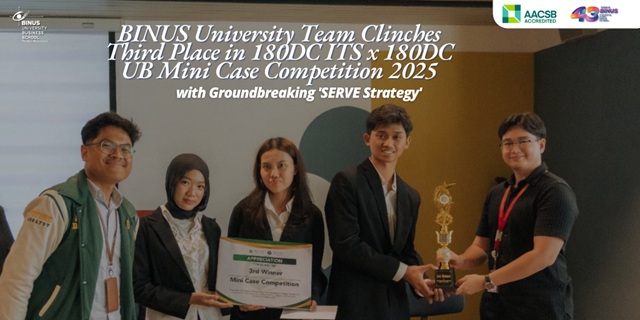
In a remarkable display of strategic acumen and innovative problem-solving, Group 63 from BINUS University secured third place in the prestigious 180DC ITS x 180DC UB Mini Case Competition 2025. Their pitch addressed the challenges faced by IndoCups, a leading styrofoam cup supplier in Surabaya, Indonesia, amid fierce price competition from newcomer Red Pots. Drawing on rigorous analysis and forward-thinking solutions, the team’s presentation not only impressed the judges but also highlighted BINUS University’s commitment to fostering top-tier consulting talent.
The Case: IndoCups’ Market Dominance Under Threat
The competition revolved around a real-world business scenario where IndoCups, holding a commanding 90% market share in Surabaya’s styrofoam cup industry, faces existential risks from Red Pots’ aggressive low-cost entry. As detailed in the team’s deck, IndoCups supplies styrofoam cups primarily to restaurant chains, but with 50% of customers prioritizing price over design or service reliability, the company risks a 5% annual revenue loss if it fails to adapt. Projections showed that without intervention, IndoCups’ market share could plummet to 75% within three years, while gross profits might decline by approximately Rp180,000,000 over four periods.
Using an SCQA (Situation-Complication-Question-Answer) framework, the team outlined the core problem: IndoCups’ high manufacturing and labor costs create a profitability disadvantage against Red Pots’ 40% cheaper products. Customer price sensitivity, indefensible market entry by competitors, and a concentrated business model (single product line and customer segment) exacerbate the issue. The central question posed was: “What can IndoCups do to strengthen its market share despite the strong price competition from Red Pots?”
Market Analysis and Customer Insights
Group 63’s analysis was thorough, incorporating market sizing, customer personas, and industry forces. They estimated Indonesia’s Total Addressable Market (TAM) for styrofoam cups at Rp17.53 trillion annually, based on 1.2 million restaurants and eateries consuming around 100 cups per day at Rp20,000 per box. Narrowing to Surabaya’s Serviceable Available Market (SAM) of 858 outlets, they projected Rp12.53 billion, with a Serviceable Obtainable Market (SOM) of Rp11.27 billion at 90% capture.
A vivid customer persona, “Adam,” a Quality Control Officer at a Surabaya restaurant chain, illustrated pain points like recurring packaging costs, supply delays, and limited transparency. The customer journey mapped from attention to loyalty emphasized the need for dependable suppliers to prevent stockouts and justify costs. Porter’s Five Forces revealed high buyer power and industry rivalry, while PESTLE analysis highlighted opportunities in Indonesia’s 4.7% GDP growth, tech penetration (>78% internet usage), and government infrastructure investments (IDR 400.3T in 2025), alongside threats from eco-regulations targeting 30% packaging waste reduction by 2029.
A cost comparison exposed Red Pots’ 33% lower production costs and lean operations, creating gaps in pricing flexibility and tech efficiency for IndoCups. The team concluded that IndoCups must pivot from cost competition to service differentiation.
Innovative Solutions: IC Smart #supplysimplified
At the heart of the “SERVE Strategy” are two pillars: IC Client Care and IC Web Optimization, branded under “IC Smart #supplysimplified.”
- IC Client Care: This personalized relationship management system positions account managers as client advocates, internal coordinators, and strategic partners. By offering tailored bulk discounts, flexible payments, and guaranteed reliable deliveries, it addresses customer churn risks. Triggered by statistics showing 72% of customers switching due to poor service, the solution promises a 36% churn reduction, 33% customer satisfaction increase, and 22% revenue boost. A narrative example with a fictional client, “Chic Safari,” demonstrated how proactive support resolves price concerns and fosters loyalty.
- IC Web Optimization: A digital platform called “Smart Serve” outsources forecasting and planning, enabling multi-branch stock monitoring, price exclusivity (e.g., 5% discounts on bi-annual bulk orders), and seamless logistics with automatic reorders at 10% inventory levels. Backed by data indicating 75% of buyers switching for better service and 48% of supply pros viewing AI as essential, this tool enhances transparency and reduces emergency reorders. Mockups showcased dashboards for demand forecasts, order tracking, and reports, ensuring a streamlined supply chain.
These solutions tackle cost structure gaps, supply inefficiencies, and client trust issues, differentiating IndoCups through reliability rather than price wars.
Feasibility and Projected Impact
The team’s feasibility study projected a two-year payback period, 38.26% ROI, Rp998.5 million NPV, and 52.61% IRR. A timeline from 2026 to 2029 outlined planning, execution, and maintenance phases, with market share rebounding from 85% in 2026 to 95% by 2028. A risk matrix identified critical areas like client optimization and sustainable loyalty, with mitigations detailed in appendices. KPIs included >30% emergency reorder reduction, >85% forecast accuracy, and a 4.7/5 CSAT score.
A Winning Formula and Lasting Legacy
In their conclusions, Group 63 emphasized that IndoCups can maintain dominance by focusing on customer needs, echoing Jeff Bezos’ quote: “We’re not competitor-obsessed, we’re customer-obsessed.” The strategy anticipates cash inflow growth from Rp1.74 billion to Rp2.08 billion over four years, solidifying profitability.
Members:
– Dimas Muhammad Ramadhani – Business Management
– Faressa Gaishani Hasnul – Management
Coach:
Najah Najmia Halim
Comments :