


BINUS University Team Aerovate Claims Third Place in KBMK Pengembangan Bisnis 2025 with SENIKA Aerogel Innovation
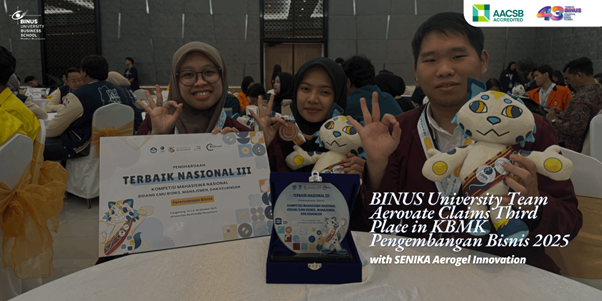
In a remarkable achievement, Team Aerovate from BINUS University secured third place nationally in the KBMK Pengembangan Bisnis 2025 competition. Under the guidance of advisor Bryna Meivitawanli, S.E., MBA, Ph.D., the team—comprising Jonathan (CEO & CFO), Kyla (CMO), and Salwa (COO)—presented their groundbreaking project, “Inovasi Aerogel Senika: Keseimbangan Kinerja dan Biaya Aerogel melalui Inovasi Material Lokal.” Their presentation addressed Indonesia’s paradox of exporting cheap raw materials like silica sand while importing expensive processed products, proposing a sustainable, locally sourced aerogel composite to enhance national industrial competitiveness and align with SDGs for decent work, industry innovation, and responsible consumption.
The Problem: Indonesia’s Downstreaming Dilemma
The team’s pitch opened with a provocative question: “Why do we sell sand cheap, but buy its processed products at high prices?” Indonesia, rich in silica sand and kapok fiber, often exports these raw materials inexpensively, only to import high-value derivatives like aerogels for thermal insulation. Current downstreaming of silica sand is limited to basic purification, yielding low added value. This gap hinders economic growth, increases import dependency, and misses opportunities in high-tech industries. Senika aims to bridge this by transforming local materials into advanced aerogel composites, boosting value addition by over 20 times and reducing reliance on costly imports.
Current Development Status and Activities
As of now, Senika is refining its aerogel formulation for commercialization through technical tests and market validation. Using a design thinking approach—Empathize, Define, Ideate, Prototype, Test—the team has outlined a timeline from January to October 2025:
- Empathize (Jan-Feb): Visits to energy, automotive, and construction factories to understand thermal insulation needs.
- Define (Mar): Identified dependency on imported aerogels and the need for efficient local alternatives.
- Ideate (Apr): Designed formulations using local silica sand, kapok fiber, and polyester.
- Prototype (May-Jul): Created two initial prototypes to compare physical and thermal properties.
- Test (Aug-Oct): Conducted university tests for thermal conductivity (ASTM C518), compressive strength (ASTM D1621), moisture stability, and high-temperature resistance.
Initial production of 50 square meters of aerogel blanket (10mm thick) serves as prototypes for lab testing and field trials, ensuring consistency, strength, lightness, and heat resistance.
Collaborations and Implementation
Team Aerovate has forged early partnerships across sectors to support development:
- Academics & Researchers: BINUS University lecturers for formula consultation, lab testing, and commercial viability.
- Industry & Corporations: Astra International and automotive manufacturers for insights on EV component insulation needs.
- Investors & Incubators: Discussions with angel investors in material engineering and green manufacturing for funding and expansion strategies.
- Government & Downstreaming Ecosystem: Initial consultations with Dinas Perindustrian, BRIN, and Kemendikbud via KBMK for technical support and local material certification.
- Suppliers: PT Borneo Silika Pasifik (Kalimantan), PT Jara Silica (Surabaya), PT Ecofiber (recycled polyester), and KapokFiber Indonesia for stable, industry-standard, sustainable supply chains.
These collaborations ensure stable raw material availability from regions like Bangka, Cirebon, and Palangkaraya for silica, and Kudus, Pati, and Pasuruan for kapok.
Innovative Solutions and Unique Selling Points
Senika’s aerogel composite, priced at Rp100,000/m², offers thermal conductivity of ~0.025–0.035 W/m·K, flexibility, and heat resistance up to ±500°C. It targets three sectors: EV battery insulation, energy pipes and hot reactors, and eco-friendly building panels/additives. Compared to competitors like Particulate Silica Aerogel (PSAS, Rp600,000/m², brittle), Fused Silica Aerogel (FSAS, Rp263,000/m²), and 3D Printed SAS (Rp150,000/m²), Senika bridges the gap between fragile low-cost options and expensive high-performance ones, using local materials for sustainability.
Challenges identified via a Severity-Occurrence Matrix include high-investment tech infrastructure, raw material supply instability, regulatory standards, market adoption of local innovations, and skilled labor shortages. Solutions involve phased scale-up, supplier partnerships, BSN/Kemenperin collaborations for SNI certification, market education via pilots and campaigns, and training programs with universities.
Market Analysis and Financial Feasibility
Market sizing shows a Total Addressable Market (TAM) of Rp9 trillion for 30,000 industries needing low-to-medium temperature insulation. The Serviceable Available Market (SAM) is Rp342 billion in key areas like Karawang, Gresik, Bekasi, and Jakarta, with a realistic Serviceable Obtainable Market (SOM) of Rp10.2 billion (3% of SAM) due to capital and competition limits.
Segmentation, Targeting, Positioning (STP):
- Geographic: Energy, automotive, construction industries in Indonesia.
- Demographic: Firms needing efficient, low-to-medium intensity insulation.
- Psychographic: Prioritizing innovation, efficiency, sustainability.
- Behavioral: Favoring cost-effective, easy-to-apply local materials.
- Positioning: “Bridge between PSAS and FSAS with strong, flexible, economical kapok-silica aerogel.”
Revenue streams include direct sales, custom specs, B2B contracts, processing services, and licensing. Projections: Year 1 focuses on validation; Year 2 on initial market capture; Year 3 achieves Rp4.36 billion (40-45% of potential); Years 4-5 expand nationally/regionally. Financial metrics: IRR 71%, Payback Period 1.21 years, BEP 89,744 m². Funding needs Rp3.5 billion from founders, angels, and ventures, allocated to HR (30.6%), machinery (15.7%), raw materials (15.5%), etc.
Impact and Downstreaming Transformation
Senika advances downstreaming by converting silica sand into high-value aerogel, increasing value >20x, reducing imports, and integrating into global supply chains. Impacts measured include:
- Natural Resources Downstreaming: Value addition per ton via chain analysis.
- Industry & Production: Output growth (+150% in 3 years) via quarterly audits.
- Economy & Local HR: Job creation and regional contributions via surveys.
- Regional Expansion: Export growth via reports.
Investor appeal, as voiced by potential backer Sandy Susanto (CEO Vinilon Group), lies in supply stability, tech independence, cost reduction, and market potential in Indonesia/ASEAN. This third-place win highlights BINUS University’s role in fostering innovative solutions for national challenges.
Members:
– Kyla Neysa Suharta – Business Creation (Alam Sutera)
– Jonathan Wijaya – Digital Business (Semarang)
– Salwa Azka Putri – Management (Bekasi)
Coach:
Bryna Meivitawanli, S.E., MBA, Ph.D
Comments :